LEGO homeschool curriculum: building unit study ideas for K-12
By Hands Down Education · Published · Updated
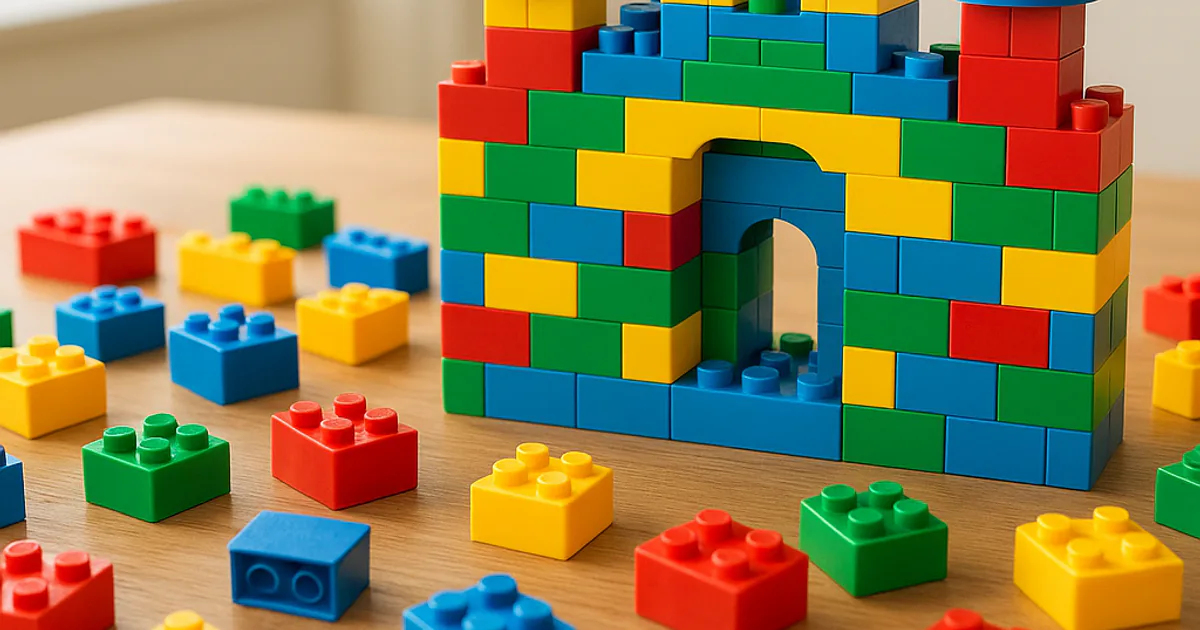
LEGO is a manipulative math kit, an engineering bench, and a storytelling stage that happens to already be all over your floor. A building-centered curriculum turns free play into directed projects: build to a constraint, document like an engineer, iterate on failure — the design loop that every technical field runs on.
The bricks' deepest lesson is decomposition: any large thing is small things arranged well. A child who has internalized that through a thousand builds applies it later to essays, code, and any problem too big to hold at once.
Build a lego & building unit for your child
Generate a complete, standards-aligned curriculum around this interest in minutes — free to try, no account required.
What your child will learn
By the end of this unit a child working at their own grade band can:
- Count bricks by color and size, sort them into groups and build a model that is the same on both sides of a line. (Math · Number Sense, K.CC.B)
- Count studs to find the area and perimeter of a build's footprint, then design a second footprint with the same area and a different perimeter. (Math · Geometry, 3.MD.C)
- Find the volume of a build in bricks, double every dimension and explain why the new volume is eight times larger. (Math · Geometry, 5.MD.C)
- Build beam, arch and truss bridges over the same gap, load each with coins until it fails and explain which design held most and why. (Science · Engineering, 3-ETS1)
- Count the teeth on two meshing gears, state the gear ratio and predict how many turns the small gear makes for one turn of the large one before testing it. (Math · Ratios, 6.RP.A)
- Build a mechanism to a written specification, test it against the spec, and record what was changed between the first version and the one that passed. (Science · Engineering, MS-ETS1)
- Build a scene from the current read-aloud and write the missing chapter it implies, with dialogue and pacing that fit the book. (Language Arts · Writing, W.4.3)
- Reconstruct a historical setting — a medieval village, a port, a pyramid site — and give a recorded tour explaining daily life in each structure. (History & Social Studies · History, C3.His)
A sample week
Reading & Writing
Build a scene from the current read-aloud, then write the missing chapter that scene implies — set design as reading comprehension.
Math
Count studs to calculate area and volume of a build; then double every dimension and discover the volume grows eightfold — the square-cube law in plastic.
Science
Build three bridge designs (beam, arch, truss) spanning the same gap and load each to failure with coins, recording collapse weights.
Social Studies
Reconstruct a studied historical setting — a medieval village, a port, a pyramid site — and give a recorded tour explaining daily life in each structure.
Art
Sculpt something organic (an animal, a face) from rectangular bricks — the constraint is the art lesson, exactly as it is in mosaic.
Get the 6-week planner + new unit ideas
A print-ready PDF of this lego & building unit study — the six-week scope and sequence, grade-band notes, reading list and FAQs — plus an occasional email when a new interest guide goes up.
Adapting by grade
K-2 learners sort by color and shape, follow visual instructions (pre-reading sequencing), count in bricks and build symmetry — foundational math with zero worksheets.
Older builders take on Technic mechanisms (gears, ratios, linkages), stop-motion filmmaking with real production planning, and original engineering challenges built to written specs.
Homeschool curriculum guides by grade band: Early Learners (K–2) · Elementary (3–5) · Middle School (6–8) · High School (9–12)
Activities by grade band
Grades K-2: sorting, counting, symmetry and following the picture
Young builders are already doing math on the floor; a K-2 unit names it. Sorting by color and size, counting bricks into groups of ten, building a model that matches on both sides of a line, and following a picture instruction sheet step by step are number sense, geometry and sequencing, and none of it needs a worksheet. The story a build implies is the writing strand told aloud.
- Sort and count: tip out a tub, sort by color into bowls, then count each bowl in groups of ten with a brick tower per ten, and write the totals on a card in front of each. How-to: build the tens as towers so the count can be checked by eye.
- Mirror build: lay a strip of tape down the middle of a base plate, have a parent build on one side and the child copy it on the other so the two halves match, then swap roles. How-to: start with five bricks and add more each round.
- Tell the build: build a scene from today's read-aloud, then tell the story of what happens next in it while a parent writes the sentences down under the photo. How-to: three sentences, the child's own words, read back together.
Reading suggestion: Iggy Peck, Architect by Andrea Beaty, the picture book about a boy who builds with everything, and the free LEGO Education early-learning activities for more sorting and pattern ideas.
Early Learners homeschool curriculum guide (grades K–2)
Grades 3-5: area, volume, bridges and the fair test
Upper elementary students can measure a build — area by counting studs, volume in bricks — and can run a real engineering fair test: three bridge designs over the same gap, each loaded with coins until it fails. Doubling every dimension and finding the volume eight times larger is the square-cube law met in plastic, and the recorded tour of a historical build is social studies with a script.
- Footprint math: count the studs to find the area and perimeter of a build's base, then design a second base with the same area but a longer perimeter and build both. How-to: graph paper first, one square per stud, then bricks.
- Bridge to failure: build a beam bridge, an arch and a truss across the same gap between two books, load each with coins in a cup until it collapses, and record the coin count for each. How-to: same gap, same cup, coins added one at a time and counted aloud.
- Double it: build a small box, record its volume in bricks, then build it again with every dimension doubled and count the volume; explain in a sentence why it is eight times and not twice. How-to: keep the two boxes side by side for the photo.
Reading suggestion: Brick City by Warren Elsmore, which shows famous buildings recreated in bricks with build notes, and the LEGO Ideas Book from DK for prompts when the tub is open and the ideas are not.
Elementary homeschool curriculum guide (grades 3–5)
Grades 6-8: gears, ratios and building to a written spec
Middle schoolers can move into mechanisms and specifications: gear ratios counted from the teeth and tested, a machine built to a written spec and judged against it, and a stop-motion film with a real production plan. The design loop — build, test against the spec, record what changed — is the same one every technical field runs on.
- Gear ratio test: mesh two gears of different sizes, count the teeth on each, predict how many turns the small one makes for one turn of the large one, then turn it and count. How-to: mark one tooth on each gear with a dot of tape so the turns can be counted.
- Build to spec: write a one-paragraph specification — 'a crane that lifts a 200-gram weight 20 centimeters and holds it' — build it, test it, and record every change between version one and the version that passed. How-to: the spec is written and signed before any bricks are touched.
- Stop-motion short: plan a thirty-second film with a shot list and a storyboard, shoot it with a free stop-motion app at twelve frames per second, and calculate how many photos that needs before starting. How-to: the storyboard has one box per shot with the number of frames written under it.
Reading suggestion: The LEGO Architect by Tom Alphin, which walks through architectural styles with builds and history for each, and The Unofficial LEGO Technic Builder's Guide by Paweł Kmieć for gears, levers and linkages.
Middle School homeschool curriculum guide (grades 6–8)
Grades 9-12: structures, mechanisms and the engineering write-up
High schoolers can treat the bricks as a prototyping material: a structure tested to failure with the load measured and graphed, a mechanism designed from a gear-ratio calculation rather than trial and error, and a written engineering report with method, data and a discussion. Done with the numbers kept, six weeks of this is a solid engineering portfolio.
- Load-to-failure study: build the same truss design in three widths, load each to failure with measured weights, graph failure load against width and write a discussion of what limited each one. How-to: use a kitchen scale to weigh the load; one graph, three points, a fitted line drawn by hand.
- Designed gearbox: calculate the gear train needed to lift a given weight with a small motor or a hand crank at a chosen speed, build it from the calculation, and compare the measured speed with the prediction. How-to: the calculation page is dated before the build and stapled to the result.
- Engineering report: write up one of the unit's builds as a full report — problem, specification, design, method, data table, results, discussion, next steps — with photographs as figures. How-to: two pages minimum, every figure numbered and referred to in the text.
Reading suggestion: The Way Things Work Now by David Macaulay for the mechanisms behind every gear, lever and pulley in the builds, and Brick by Brick by David Robertson on how the LEGO company nearly failed and recovered, for the economics strand.
Six-week scope and sequence
| Week | Focus | Key activity | Output |
|---|---|---|---|
| 1 | The tub as a math kit | Sort and count in tens; mirror build across a tape line; count studs for the area and perimeter of a base plate. Skill from the list above: count bricks by color and size, sort them and build a model that is the same on both sides of a line (K.CC.B). | A photo of the sorted tub with counts and a symmetrical build across the tape line. |
| 2 | Bridges and the fair test | Beam, arch and truss bridges over the same gap loaded with coins to failure; write which held most and why. Skill: build three bridge designs, load each until it fails and explain which held most and why (3-ETS1). | A three-row results table with the collapse count for each design and a paragraph of conclusions. |
| 3 | Area, volume and the square-cube law | Same-area different-perimeter footprints; the double-it box; older students plan the three-width truss study. Skill: find the volume of a build in bricks, double every dimension and explain why the volume is eight times larger (5.MD.C). | Two footprints with the math shown and a photo of the two boxes with the eightfold explanation. |
| 4 | Gears and ratios | The gear ratio test with marked teeth; a two-gear machine that turns something slowly; teens calculate a gearbox before building it. Skill: count the teeth on two meshing gears, state the ratio and predict the turns before testing (6.RP.A). | A gear table with predicted and measured turns and a working two-gear mechanism. |
| 5 | Build to a written specification | Write the spec, build, test against it and log every change to the passing version; storyboard the stop-motion short. Skill: build a mechanism to a written specification, test it against the spec and record what changed (MS-ETS1). | A signed spec, a version log and a mechanism that passes its own test. |
| 6 | Story, history and the report | Build the scene from the read-aloud and write the missing chapter; reconstruct a historical setting and record the tour; teens write the engineering report. Skill: reconstruct a historical setting and give a recorded tour explaining daily life in each structure (C3.His). | A recorded tour of the historical build, a written chapter and, for older students, a two-page engineering report. |
Materials and free resources
- A tub of generic bricks and base plates, two books to bridge between, and a jar of coins for the load tests.
- Graph paper and a notebook for the area, volume and load data; a phone or tablet for the recorded tour and any stop-motion filming.
- LEGO Education (education.lego.com): free lesson plans and building challenges written for classrooms, usable with any bricks.
- PBS Kids Design Squad (pbskids.org/designsquad): free engineering challenges and build guides for elementary and middle grades.
- NASA STEM Engagement (nasa.gov/stem): free engineering-design challenges, including structures and landers, for the build-to-spec weeks.
- Smithsonian Learning Lab (learninglab.si.edu): free photographs and drawings of historical buildings and settlements to research before a reconstruction build.
- Khan Academy (khanacademy.org): free practice on area, perimeter, volume and ratios to run alongside the measurement builds.
Common questions
Is LEGO learning or just playing?
Both, on a dial you control. Free play builds spatial intuition on its own; add a constraint and a deliverable, and the same bricks are a genuine engineering assignment.
Do we need the expensive robotics sets?
No. A generic brick tub carries years of math, engineering and storytelling. Technic adds mechanisms; robotics adds programming — worthwhile upgrades, never prerequisites.
How does building teach writing?
Builds generate narrative naturally — who lives here, what went wrong, what happens next. Instructions, tour scripts, and story chapters all flow out of what's on the table.
How do I start a LEGO unit study?
Start with the bricks already on the floor and one constraint. Ask for a bridge that spans the gap between two books, then load it with coins until it fails and write down the number; that single afternoon is an engineering fair test, and the second and third bridge designs follow on their own. In the same week, count studs to find the area of a base plate and build a scene from the current read-aloud. Nothing needs to be bought: a generic tub carries the whole six weeks, and the Technic and robotics sets are upgrades for later, not prerequisites.
Is LEGO educational for homeschool?
It is when a build has a constraint and a deliverable, and it is play when it does not; both have value, but only the first is curriculum. Counting, area, volume and the square-cube law are math done in plastic; bridges loaded to failure and mechanisms built to a written spec are engineering; a reconstructed historical setting with a recorded tour is social studies; and the story a scene implies is writing. The skills list above names what a six-week unit actually teaches and which strand of the standards each one lands on. Keep daily math practice and a sequenced reading program running alongside; the bricks carry the rest.
Related curriculum ideas
 Minecraft homeschool curriculum
Use Minecraft as a genuine homeschool teaching tool — math, engineering, history builds, creative writing and even economics, for K-12.
 Robots & Coding homeschool curriculum
Build a homeschool curriculum around robots and coding — programming, engineering design, math and the ethics of automation, for K-12.
 Trains homeschool curriculum
Turn a train obsession into a homeschool curriculum — engineering, industrial history, geography and math built around railroads, for K-12.
Ready to build a lego & building unit for your child?
Generate a complete, standards-aligned curriculum around this interest in minutes — free to try, no account required.