Ancient Rome homeschool curriculum: unit study ideas for K-12
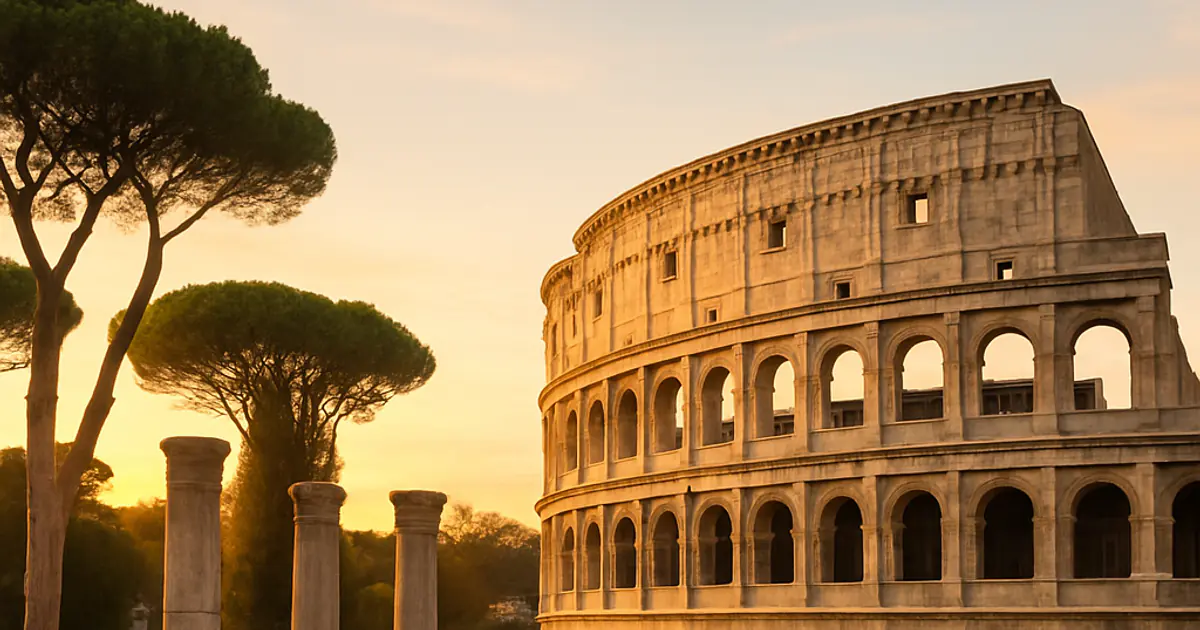
Rome is the civilization a child can still walk on. Its roads are under European highways, its aqueducts still stand, its calendar is on the wall, its alphabet is on this page and its law and its republic are built into every constitution written since. An ancient Rome unit study starts from that: a small town on the Tiber that became, over a thousand years, a republic, then an empire that ran from Scotland to Syria, then a memory that everyone afterward tried to copy.
It carries every subject without effort. Reading gets Roman myths and Caesar's own account of Gaul; math gets Roman numerals, the arch and the scale drawing of an aqueduct; science gets concrete, roads and engineering that still works; social studies gets the Republic's checks and balances, the transition to emperors, and the question of why it fell; and art and language get mosaics, columns and the Latin under half of English. A six-week Rome unit is a legitimate slice of world history at any grade.
A sample week
Reading & Writing
Read the legend of Romulus and Remus and the historian Livy's short version of it, then write a news report of the city's founding that separates what the legend says from what archaeology can actually show.
Math
Write today's date, every family member's age and the house number in Roman numerals, then work out why adding in Roman numerals is so hard — and why Roman merchants used an abacus instead.
Science
Build a Roman arch from cardboard blocks cut as wedges over a curved form, remove the form, and load it with books until it fails. Then explain in writing why the keystone holds and why the Romans could build so much higher than the Greeks.
Social Studies
Chart the Roman Republic's government — two consuls, the Senate, the assemblies, the tribunes with their veto — and match each piece to a part of your own government, noting where the Founders copied Rome on purpose.
Art
Make a mosaic of a Roman subject from cut paper squares or beans on a board, working from a photograph of a real floor at Pompeii; the constraint of squares is the whole art.
Get the 6-week planner + new unit ideas
A print-ready PDF of this ancient rome unit study — the six-week scope and sequence, grade-band notes, reading list and FAQs — plus an occasional email when a new interest guide goes up.
Adapting by grade
K-2 learners hold Rome through objects and story: the wolf and the twins, a Roman soldier's kit, numerals on a clock face, a mosaic made from squares, and the Latin words they already say — 'exit', 'et cetera', 'video'. The dates can wait.
Middle and high schoolers can read Caesar, Cicero and Tacitus in short extracts, argue whether Caesar was a tyrant or a reformer, compare the Republic's checks and balances with their own constitution, and take on the fall of Rome as a real historical debate with multiple causes.
Activities by grade band
Grades K-2: the wolf, the soldier, the numbers and the squares
Young children meet Rome as a set of vivid things: a she-wolf feeding two babies, a soldier with a red shield and a crest, numbers written with letters, pictures made of tiny squares, and a city buried under ash with the bread still in the oven. A K-2 unit is stories, objects, counting and making, with then-and-now comparison as the skill underneath.
- Read the legend of Romulus and Remus, then retell it with drawings in four panels — the basket on the river, the wolf, the argument about the hill, the wall. Talk about which parts could be true and which are a story people told later.
- Make a Roman soldier's kit from cardboard: a curved rectangular shield (scutum) with a painted design, a short sword and a crested helmet. Then learn the 'tortoise' — shields overhead and in front — with every family member and see whether a thrown sock can get through.
- Learn the Roman numerals I, V and X, write the numbers 1 to 20 with them, and find them around the house: clock faces, book chapters, the copyright line at the end of a film. Write your age and the year in numerals on a clay tablet.
- Make a mosaic of a fish, a dog or a bird from cut paper squares or dried beans glued to card, working from a photograph of a real Pompeii floor. Notice that Roman artists could not draw a curve — only suggest one with squares.
Reading suggestion: Rome Antics by David Macaulay, a pigeon's-eye tour of the city old and new, and Ancient Rome and Pompeii: A Magic Tree House Fact Tracker by Mary Pope Osborne for a first nonfiction walk through daily life and the buried city.
Grades 3-5: daily life, Pompeii, roads and the Republic
Upper elementary students can hold Rome as a place and a system: a city with apartments, baths, markets and games, an army that built roads as it marched, and a government with rules about who decided what. Pompeii makes daily life concrete; the arch and the aqueduct make engineering hands-on; and the Republic makes a first lesson in checks and balances.
- Take a virtual walk through Pompeii (the archaeological park and several museums offer free tours), then write a day in the life of a Roman child there in August of AD 79 — school, the market, the baths, the graffiti on the walls — ending the morning the mountain erupted, using Pliny the Younger's eyewitness letter for the details.
- Build a Roman road in a shoebox in four layers — large stones, gravel, sand, fitted paving — with a crown in the middle and ditches at the sides, then explain in writing why the layers made it last two thousand years. Map the major roads out of Rome and find the one that gave us the saying about all roads.
- Make a chart of the Republic's government — consuls, Senate, assemblies, tribunes — with what each could do and who could belong, then draw arrows for the checks: the veto, the one-year term, the two consuls. Compare it with your own government in a second column.
- Build the cardboard arch: cut wedge-shaped blocks, stack them over a curved form, add the keystone, remove the form and load the arch with books until it fails. Record the weight it held, then read how the Colosseum used arches in three rings to hold fifty thousand people.
Reading suggestion: Detectives in Togas by Henry Winterfeld, a mystery set in a Roman school that carries the daily-life strand, and DK Eyewitness: Ancient Rome for the object-by-object reference to keep open all unit.
Grades 6-8: Republic to Empire, engineering and sources
Middle schoolers can work with Rome's central drama — how a republic with careful checks became a monarchy in all but name — and with the engineering as real applied math. Short extracts of Caesar, Cicero and Suetonius become readable here, and the writing shifts to comparison and argument from evidence.
- Trace the fall of the Republic through five people — the Gracchi, Marius, Sulla, Caesar, Augustus — with a page per person answering the same three questions: what problem did they face, what rule did they break, and what did that make possible for the next one? Finish with a verdict on whether Caesar caused the end of the Republic or inherited it.
- Design an aqueduct on paper to carry water from a spring 30 kilometers away with a drop of 1 meter per kilometer (a real Roman gradient): calculate the total drop, draw the profile to scale, and decide where an arcade, a tunnel and a siphon would be needed. Then read how the Pont du Gard was actually built.
- Read Caesar's own account of the siege of Alesia in his Gallic War alongside a modern historian's version, and write a page on what Caesar leaves out, what he exaggerates and why a general writing for readers in Rome would do so. This is the unit's lesson in reading a source against its author.
- Stage a Senate debate on a real Roman question — should Rome grant citizenship to its Italian allies, or should land be redistributed to veterans — with each speaker in a named role and required to cite one fact from the reading. Write the vote and the reasoning as the Senate's own minutes.
Reading suggestion: Augustus Caesar's World by Genevieve Foster, a homeschool classic that sets Rome inside everything else happening in the world at the time, plus selected chapters of Mary Beard's SPQR read together with support and Caesar's Gallic War Book VII in translation for the Alesia extract.
Grades 9-12: Rome as an argument that never ended
High schoolers can read the Romans themselves — Livy, Cicero, Tacitus, Pliny, the Twelve Tables — and take up the questions historians still argue: why the Republic failed, whether the Empire was a good or a bad thing for the people in it, how Christianity moved from persecuted sect to state religion, and why the West fell while the East lasted another thousand years. With source-based essays and a research paper, six weeks of this is a substantial slice of a world history credit.
- Read Cicero's First Catilinarian and Sallust's account of the same conspiracy, and write an essay on how far the two agree, what each author wanted his readers to believe, and what a historian can establish about what actually happened. Cite both texts throughout.
- Read the surviving fragments of the Twelve Tables, Rome's first written law code, and compare them with the Code of Hammurabi and with the first ten amendments of the U.S. Constitution on three questions: who is protected, what counts as evidence, and what the punishments are. Write up the comparison as a legal brief.
- Take on the fall of the Western Empire as a research question: read Gibbon's famous summary and one modern account (Peter Heather or Bryan Ward-Perkins), list the proposed causes — military, economic, climatic, religious, political — and write a paper that weighs them and explains why the Eastern Empire, with the same religion and law, survived.
- Trace Roman law into your own country: choose three principles — innocent until proven guilty, the right to face an accuser, property and contract law — and follow each from the Roman jurists through the Justinian Code to a modern statute or court decision, with at least three sources, one of them primary.
Reading suggestion: SPQR: A History of Ancient Rome by Mary Beard as the spine, with the primary texts — Livy's early books, Cicero's speeches, Tacitus' Agricola and Annals, Pliny's letters — in any modern translation or the free editions on the Perseus Digital Library and LacusCurtius.
Six-week scope and sequence
| Week | Focus | Key activity | Output |
|---|---|---|---|
| 1 | The land, the founding and the Republic | Map Italy and the Mediterranean; Romulus and Remus against archaeology; chart the Republic's government and its checks and balances. | An annotated map, a legend-versus-evidence chart and a government diagram. |
| 2 | Daily life and Pompeii | Homes, food, baths, school, games and slavery through Pompeii; cook a Roman meal; make a mosaic; read Pliny's eruption letter. | A day-in-the-life diary from Pompeii and a finished mosaic. |
| 3 | The army, roads and engineering | Build the layered road and the cardboard arch; design an aqueduct on a real gradient; the legion and how it conquered. | A working arch with its recorded load and a scale aqueduct profile with the calculation shown. |
| 4 | From Republic to Empire | Carthage and the Punic Wars; the Gracchi to Augustus; read Caesar against a modern historian; stage a Senate debate. | A five-person chart of the Republic's fall with a written verdict on Caesar. |
| 5 | The Empire at its height | Trajan's Rome to Hadrian's Wall; trade, citizenship and law; Roman religion, the Jews and the early Christians; Latin roots in English. | A map of the Empire's provinces and trade with a paragraph on what held it together, and a Latin-roots word list. |
| 6 | Decline, fall and legacy | Weigh the causes of the Western fall; the East survives; trace Roman law, language and architecture into today; final project. | A final essay, research paper, model or exhibit with an evidence-based claim about what Rome left behind. |
Standards this unit covers
- D2.His.2.3-5 (C3) — Compare life in specific historical time periods to life today — the Pompeii daily-life strand.
- D2.Civ.3.6-8 (C3) — Examine the origins, purposes and impact of constitutions, laws, treaties and international agreements — the Republic's government and the Twelve Tables.
- D2.His.3.6-8 (C3) — Use questions generated about individuals and groups to analyze why they, and the developments they shaped, are seen as historically significant — the Gracchi-to-Augustus chart.
- D2.Geo.4.6-8 (C3) — Explain how cultural patterns and economic decisions influence environments and the daily lives of people in both nearby and distant places — roads, aqueducts and the Mediterranean trade.
- D2.His.14.9-12 (C3) — Analyze multiple and complex causes and effects of events in the past — the fall of the Western Empire.
- CCSS.ELA-LITERACY.RH.9-10.6 (CCSS ELA) — Compare the point of view of two or more authors for how they treat the same or similar topics — Cicero against Sallust, Caesar against a modern historian.
- CCSS.ELA-LITERACY.W.6.1 (CCSS ELA) — Write arguments to support claims with clear reasons and relevant evidence — the verdict on Caesar and the Senate debate minutes.
- CCSS.MATH.CONTENT.7.G.A.1 (CCSS Math) — Solve problems involving scale drawings of geometric figures — the aqueduct profile and the road and arch models.
Recommended books, sites and kits
- Rome Antics by David Macaulay (Book (K-2)) — A homing pigeon's flight over Rome, ancient and modern, drawn by the author of Cathedral and City.
- Detectives in Togas by Henry Winterfeld (Book (3-5)) — A mystery set among schoolboys in imperial Rome; the daily-life strand as a read-aloud novel.
- DK Eyewitness: Ancient Rome (Book (3-8)) — Photographs of real objects — armor, coins, tools, mosaics — with readable captions; the shelf reference for the whole unit.
- City: A Story of Roman Planning and Construction by David Macaulay (Book (3-8)) — How a Roman town was laid out and built, from survey to aqueduct to forum, in Macaulay's cutaway drawings.
- SPQR: A History of Ancient Rome by Mary Beard (Book (9-12)) — The current standard one-volume history by a Cambridge classicist; selected chapters work for middle school with support.
- Perseus Digital Library and LacusCurtius (Website) — Free translations of Livy, Caesar, Cicero, Tacitus, Pliny and the Twelve Tables, with the Latin alongside on Perseus.
- Pompeii Archaeological Park and the British Museum's Roman galleries (online) (Website) — Virtual tours, object pages and free teaching resources for the daily-life and art strands.
- Engineering an Empire: Rome (History Channel) and Khan Academy's Roman art units (Video series) — The engineering episode covers roads, aqueducts, the Colosseum and the Pantheon; Khan Academy's short art videos cover the Forum, mosaics and portraiture.
Common questions
What should an ancient Rome unit study include?
A complete ancient Rome unit study covers the geography of Italy and the Mediterranean, the founding and the Republic (its government and its wars with Carthage), daily life in the city — homes, food, baths, games, slavery — Roman engineering and the army, the change from Republic to Empire through Caesar and Augustus, and the long decline and fall in the West. Latin and the Roman legacy in law, language and building run through all six weeks. The scope and sequence above takes those in order and ends with a project.
Is ancient Rome appropriate for young children?
Yes, with the right doors in. Romulus and Remus, the soldier's kit, Roman numerals, mosaics, roads and the city of Pompeii frozen by a volcano are all K-2 material. The gladiator games, the crucifixions and the scale of Roman slavery belong in the upper bands, where they can be discussed honestly. The grade-band activities are chosen so younger children share the week without meeting content they are not ready for.
How does Rome cover math and science, not just history?
Roman engineering is applied physics that still stands. The arch and the dome, concrete that sets under water, aqueducts that carry water fifty miles on a gradient of a few feet per mile, and roads built in layers are all hands-on activities in this guide, with the math of gradient, scale drawing and load. Roman numerals and the abacus are a real lesson in why place value matters. A week of Roman engineering is a legitimate week of science and geometry.
Should we learn Latin as part of this?
A little, and it pays off for years. This guide uses Latin as vocabulary — roots that explain English words, the mottoes on coins and buildings, the numerals and the months — rather than as a grammar course. Families who want more can start a beginner Latin program alongside the unit; the 6-8 and 9-12 activities include short passages of Caesar and Cicero in translation with the Latin alongside so students see how much they can already read.
Can I run a Rome unit with several ages at once?
It is one of the best history topics for that. Everyone builds the same arch and eats the same Roman lunch; the output changes by age. A first grader retells Romulus and Remus with drawings, a fourth grader writes a Roman child's diary from Pompeii, a seventh grader charts the Republic against the U.S. Constitution, and a tenth grader argues whether the Republic fell because of Caesar or because of what came before him. The grade-band sections above are written so you can pick one row per child from the same week.
How do we handle slavery, the games and the conquests?
Honestly, at the age that can handle them. Rome ran on enslaved labor, entertained itself with death in the arena and built its wealth on conquest; a unit that skips those is not history. The 6-8 and 9-12 activities put them at the center — who counted as a person under Roman law, what Spartacus's revolt was about, what Tacitus meant by 'they make a desert and call it peace.' For K-2 and 3-5 the guide keeps to daily life, objects, story and engineering.
Does this unit work for secular and faith-based homeschools alike?
Yes. This guide treats Roman religion as history — the gods, the festivals, the emperors' cult and the place of Jews and early Christians in the Empire — and treats the rise of Christianity in the 9-12 band as a historical development to be read from sources. Families of any worldview use the same maps, models and texts; where a reading touches belief directly, the grade band notes it so you can frame it your way.
How much does an ancient Rome unit study cost?
Very little. The reading spine is library books; the primary sources — Livy, Caesar, Pliny's letters, Tacitus — are free online in older translations; the hands-on work needs cardboard, beans or paper squares, air-dry clay and a few books to load the arch. Museum websites supply the images and the virtual tours of Pompeii and the Forum. A museum trip is a good extra, not a requirement.
Related curriculum ideas
 Ancient Greece homeschool curriculum
An ancient Greece homeschool curriculum for K-12 — Athens and Sparta, democracy, the Olympics, philosophy and myth taught through reading, geography, math and art, with a six-week plan.
 American Revolution homeschool curriculum
An American Revolution homeschool curriculum for K-12 — causes, battles, the Declaration, Loyalists and Patriots, and the Constitution taught through primary sources, maps, math and art.
 Ancient Egypt homeschool curriculum
A homeschool curriculum built around Ancient Egypt — archaeology, hieroglyphs, engineering and daily life along the Nile, for K-12.
Turn this into a full curriculum
Generate a complete, standards-aligned curriculum around this interest in minutes — free to try, no account required.