Ancient Greece homeschool curriculum: unit study ideas for K-12
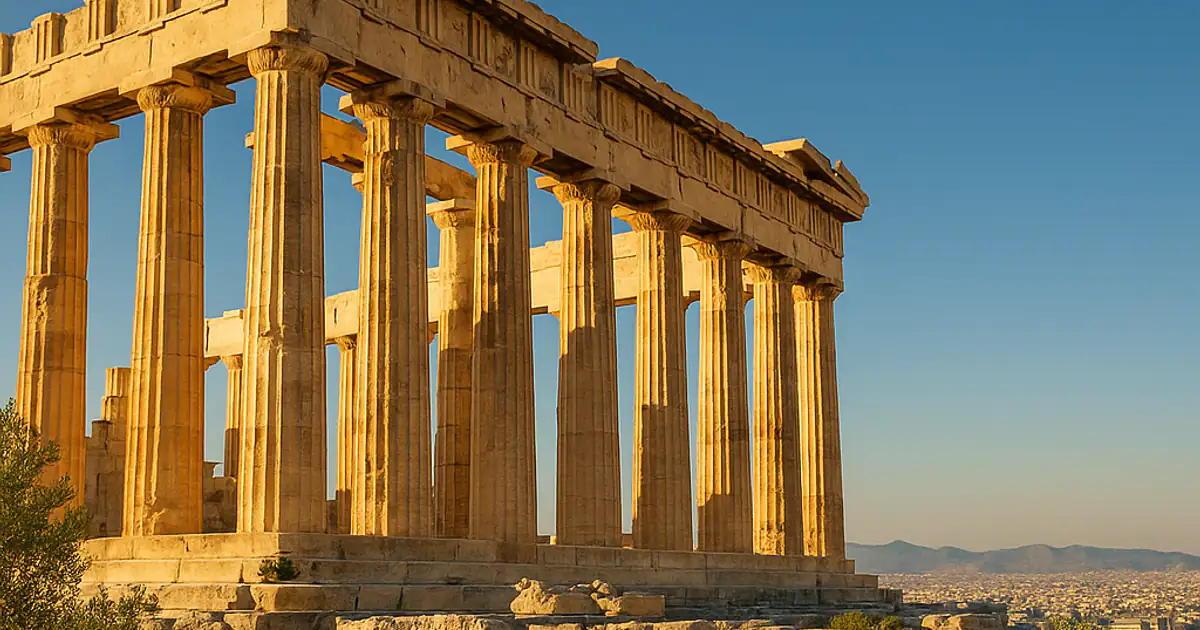
Ancient Greece is where a surprising amount of the modern world was first argued out loud: voting, trial by jury, the Olympic Games, geometry proved from axioms, history written from sources, theater with a plot, and the habit of asking a question and following the answer. An ancient Greece unit study lets a child meet all of that where it started — in a handful of small city-states on a rocky peninsula, over roughly four centuries.
It is a natural homeschool spine because every subject has a Greek chapter. Reading gets the Odyssey and Aesop; math gets Pythagoras, Euclid and Archimedes with actual constructions to do; science gets the first people who tried to explain the world without gods; social studies gets Athens and Sparta as two experiments in how to run a society; and art gets pottery, columns and the Parthenon. The myths are in our separate mythology guide; this one is the history, the ideas and the daily life.
A sample week
Reading & Writing
Read a retelling of the Odyssey's Cyclops episode, then write the same scene from Polyphemus's point of view — the first lesson in how the teller shapes the story.
Math
Prove the Pythagorean theorem the way a Greek would, by cutting and rearranging squares on paper, then use it to check whether the corner of a room is square with a 3-4-5 triangle.
Science
Replicate Eratosthenes' measurement of the Earth: measure a stick's shadow at local noon, compare with a friend or a published reading from a city due north or south, and calculate the planet's circumference.
Social Studies
Hold a family assembly on a real question (screen time, the weekend plan) using Athenian rules — everyone speaks, majority decides — then hold it again with Spartan rules, and write which was fairer and which was faster.
Art
Design a Greek vase: draw an amphora outline, choose black-figure or red-figure, and fill the band with a scene from the week's reading in the flat, profile style of the originals.
Get the 6-week planner + new unit ideas
A print-ready PDF of this ancient greece unit study — the six-week scope and sequence, grade-band notes, reading list and FAQs — plus an occasional email when a new interest guide goes up.
Adapting by grade
K-2 learners hold ancient Greece through story and objects: Aesop's fables, a Greek alphabet chart, an olive and a fig to taste, columns to spot on the courthouse downtown. The dates do not matter yet; the idea that people lived long ago and left things behind does.
Middle and high schoolers can read Herodotus and Thucydides in short extracts, compare Athenian democracy with their own government clause by clause, follow a Euclidean proof and argue a Socratic question — which is when the unit becomes civics, geometry and philosophy at once.
Activities by grade band
Grades K-2: fables, games, letters and objects
Young children meet ancient Greece as a place where people lived long ago and left stories and things behind. A K-2 unit is fables read aloud, the first Olympic Games acted out, letters of a different alphabet, food that Greeks ate and still eat, and objects to hold and make. Sequence and comparison — then and now — are the real skills underneath.
- Read three of Aesop's fables — the Tortoise and the Hare, the Boy Who Cried Wolf, the Lion and the Mouse — act each one out, and say the moral in your own words. Then invent a fable with two animals and a lesson, and draw it.
- Hold a backyard Olympics with the ancient events that translate: a running race, a standing long jump, a discus throw with a paper plate and a javelin throw with a pool noodle. Make an olive-wreath crown from paper leaves for every competitor, as the Greeks did — no medals.
- Write your name in Greek letters using an alphabet chart, then find the Greek letters hiding in English: alpha, beta, delta, pi. Notice that 'alphabet' is just the first two letters said together.
- Have a Greek lunch — olives, feta, flatbread, honey, figs, grapes and cucumber — and sort the foods by whether a Greek child could have eaten them. Then make a pinch-pot from air-dry clay and decorate it with a wave or key pattern in black paint.
Reading suggestion: The Aesop for Children (the classic Milo Winter edition), and Ancient Greece: A Magic Tree House Fact Tracker by Mary Pope Osborne for a first nonfiction walk through daily life, the Olympics and the gods.
Grades 3-5: city-states, daily life and the Odyssey
Upper elementary students can hold ancient Greece as a map and a story: mountains and sea, city-states that competed and traded, Athens against Sparta, and a long poem about getting home. This is the age for the Odyssey in a good retelling, for a real comparison of two societies, and for the first Greek mathematics done with hands.
- Map Greece with the mountains and coastline drawn in, then place Athens, Sparta, Corinth, Thebes, Olympia and Delphi, and explain in a paragraph why the geography produced many small city-states rather than one kingdom. Add the colonies around the Mediterranean and Black Sea to show how far Greek ships went.
- Make an Athens-versus-Sparta chart with rows for government, schooling, the role of women, the army and what each city was proudest of, filled in from your reading. Then write a diary entry as a ten-year-old in each city on the same day.
- Read the Odyssey in a children's retelling one episode at a time — the Cyclops, the Sirens, Circe, the return — and keep a map of Odysseus's route with a sentence per stop. Finish by writing a new adventure for him in the same style.
- Prove the Pythagorean theorem by cutting squares: draw a right triangle with sides 3, 4 and 5 on grid paper, build the square on each side from unit squares, and show that the two small squares fill the big one exactly. Then use a 3-4-5 rope triangle to check a corner of the house.
Reading suggestion: The Adventures of Odysseus by Hugh Lupton and Daniel Morden, a storyteller's retelling that reads aloud beautifully, and DK Eyewitness: Ancient Greece for the object-by-object reference to keep open all unit.
Grades 6-8: democracy, war and the first historians
Middle schoolers can work with what makes Greece matter: how Athenian democracy actually ran, who it included and excluded, why Athens and Sparta went to war, and how Herodotus and Thucydides invented the idea of writing history from evidence. Short primary-source extracts become readable here, and the writing shifts to comparison and argument.
- Reconstruct an Athenian assembly day: who could attend (free adult male citizens — roughly a tenth of the people in Attica), how the agenda was set by the Council of 500, how votes were taken, and what ostracism was. Then compare it clause by clause with your own national government in a two-column chart and write which system gives an ordinary person more direct power.
- Read Herodotus on the battle of Thermopylae and Marathon in short extracts, mark on a map the Persian route and the Greek positions, and write a page on what Herodotus says he saw himself, what he heard from others and what he seems to have invented — the beginning of source criticism.
- Stage a Socratic dialogue: pick one question (what is courage? is it ever right to break a law?), have one person play Socrates asking only questions and the other defend an answer, and record where the answer had to change. Write a reflection on why Athens found this dangerous.
- Repeat Eratosthenes' experiment properly: measure the shadow angle of a vertical stick at solar noon, find a partner city's angle from a published reading or a friend at a different latitude, use the distance between the cities and the difference in angles to calculate the Earth's circumference, and compare with the real value.
Reading suggestion: The Greeks: An Illustrated History by Diane Harris Cline (National Geographic) as the spine, with short extracts from Herodotus' Histories and Thucydides' account of the plague of Athens read together.
Grades 9-12: Greek thought, sources and the long shadow
High schoolers can read the Greeks themselves — Pericles' funeral oration, a Platonic dialogue, a Greek tragedy, a book of Euclid — and take up the questions historians still argue: why Athens lost, whether Athenian democracy deserves the name, and how much of the modern world is really Greek. With essays and a source-based research paper, six weeks of this is a substantial slice of a world history or humanities credit.
- Read Pericles' funeral oration in Thucydides and write an analysis of it as a piece of persuasion: what it claims Athens is, who it leaves out, and what Thucydides — who reports it — might have thought, given how his history ends. Cite the text throughout.
- Read Plato's Apology in full and write a two-page essay taking a position on Socrates' trial: was Athens right to fear him, and does his defense answer the charges? Bring in what you know about the democracy's recent defeat and the rule of the Thirty.
- Work through the first ten propositions of Euclid's Elements, Book I, with compass and straightedge, writing each proof in your own words. Then explain what Euclid was doing that no one had done before — building everything from a few stated assumptions — and where the same method shows up today.
- Research paper: choose one legacy — trial by jury, the theater, the Hippocratic tradition, the Olympic revival, the architecture of civic buildings — and trace it from Greece to your own country with at least three sources, one of them primary, and an argument about how much really survived and how much was reinvented.
Reading suggestion: The Classical World by Robin Lane Fox for the narrative spine, alongside the primary texts — Thucydides, Plato's Apology, Sophocles' Antigone and Euclid's Elements Book I — in any modern translation or the free Perseus Digital Library editions.
Six-week scope and sequence
| Week | Focus | Key activity | Output |
|---|---|---|---|
| 1 | The land and the city-states | Map the mountains, coasts, islands and colonies; explain why Greece became many city-states; begin the timeline from the Minoans to Alexander. | An annotated map and a timeline with the first ten events placed. |
| 2 | Daily life: Athens and Sparta | Compare homes, schooling, food, clothing and the lives of women and the enslaved in the two cities; cook a Greek meal; make a clay pot. | An Athens-versus-Sparta chart and a diary entry from each city. |
| 3 | Government and citizenship | Reconstruct the Athenian assembly, council and jury; hold a family assembly two ways; older students compare with their own constitution. | A comparison chart of Athenian and modern government with a written judgment. |
| 4 | The wars and the historians | Persian Wars (Marathon, Thermopylae, Salamis) and the Peloponnesian War through Herodotus and Thucydides; map the campaigns; source criticism. | A campaign map and a page on what a historian can and cannot know. |
| 5 | Ideas: math, science, philosophy, theater | Pythagorean proof, Euclid's constructions, Eratosthenes' Earth; a Socratic dialogue; read or perform a scene of Greek drama; the Olympics. | A written proof or measurement with the calculation shown, and a dialogue transcript. |
| 6 | Art, architecture and legacy | Column orders, the Parthenon, vase painting; Alexander and the spread of Greek culture; trace one Greek legacy into today; final project. | A decorated vase or column model and a final presentation, newspaper, essay or research paper. |
Standards this unit covers
- D2.Geo.2.3-5 (C3) — Use maps, satellite images, photographs and other representations to explain relationships between the locations of places and regions and their environmental characteristics — why mountains and sea made city-states.
- D2.His.2.3-5 (C3) — Compare life in specific historical time periods to life today — the daily-life strand and the Athens-versus-Sparta chart.
- D2.Civ.2.6-8 (C3) — Explain specific roles played by citizens such as voters, jurors, taxpayers, members of the armed forces, petitioners, protesters and office-holders — the Athenian assembly, council and jury.
- D2.His.1.6-8 (C3) — Analyze connections among events and developments in broader historical contexts — the Persian Wars, the rise of Athens and the Peloponnesian War.
- D2.His.16.9-12 (C3) — Integrate evidence from multiple relevant historical sources and interpretations into a reasoned argument about the past — the 9-12 essays and research paper.
- CCSS.ELA-LITERACY.RH.6-8.1 (CCSS ELA) — Cite specific textual evidence to support analysis of primary and secondary sources — the Herodotus and Thucydides extracts.
- CCSS.ELA-LITERACY.RL.4.9 (CCSS ELA) — Compare and contrast the treatment of similar themes and topics and patterns of events in stories, myths and traditional literature from different cultures — Aesop and the Odyssey.
- CCSS.MATH.CONTENT.8.G.B.6 (CCSS Math) — Explain a proof of the Pythagorean theorem and its converse — the cut-and-rearrange proof and the 3-4-5 check.
Recommended books, sites and kits
- The Aesop for Children (Milo Winter illustrations) (Book (K-2)) — The classic illustrated fables, short enough to read three at a sitting and act out.
- The Adventures of Odysseus by Hugh Lupton and Daniel Morden (Book (3-5)) — A storyteller's retelling of the Odyssey that reads aloud one episode at a time; the 3-5 reading spine.
- DK Eyewitness: Ancient Greece (Book (3-8)) — Photographs of real objects — armor, pottery, coins, tools — with captions a fourth grader can read alone; the shelf reference.
- The Greeks: An Illustrated History by Diane Harris Cline (Book (6-8)) — A National Geographic narrative from the Bronze Age to Alexander, written by a classicist, with maps and timelines.
- The Classical World by Robin Lane Fox (Book (9-12)) — A readable one-volume history of Greece and Rome by an Oxford historian; the high-school spine for this guide and the ancient Rome guide together.
- Perseus Digital Library (Tufts University) (Website) — Free, searchable translations of Herodotus, Thucydides, Plato, the tragedians and Euclid, with the Greek alongside.
- The British Museum: Ancient Greece resources (Website) — Free object-based teaching pages and galleries on the Parthenon sculptures, pottery, the Olympics and daily life.
- Acropolis Museum virtual tour and the Parthenon (Khan Academy / Smarthistory) (Website / video) — Short, expert-narrated videos on the Parthenon, vase painting and the column orders for the week-six art strand.
Common questions
What should an ancient Greece unit study include?
A complete ancient Greece unit study covers geography (why the mountains and the sea made city-states rather than one kingdom), daily life in Athens and Sparta, government (assembly, jury, citizenship and who was left out), the Persian and Peloponnesian wars, the ideas — philosophy, mathematics, medicine, theater, the Olympics — and the art and architecture. The six-week scope and sequence above takes those in order and ends with a project. Myths deserve their own unit; our mythology guide covers them.
Is ancient Greece appropriate for young children?
Yes, with the right entry points. Aesop's fables, the Olympic Games, the Trojan horse, the Greek alphabet and the food are all K-2 material; the wars and the slavery of the period are better left to the upper bands, where they can be discussed honestly. The grade-band activities above are chosen so a six-year-old and a twelve-year-old can share a week without the younger one meeting content that is not ready for them.
How does ancient Greece cover math and science, not just history?
Directly. Greek mathematics is the origin of proof: the Pythagorean theorem, Euclid's constructions with compass and straightedge, Archimedes' work on levers and buoyancy, and Eratosthenes' measurement of the Earth are all hands-on activities in this guide. Science gets Hippocrates and the first natural explanations of disease, and Aristotle's classification of animals. A week of Greek math is a legitimate week of geometry.
How is this different from the mythology guide?
The mythology guide treats the myths as literature — the gods, heroes and stories and what they meant. This guide is the history: real people, real cities, real wars and real inventions, and how Greek ideas about government, mathematics and knowledge shaped what came after. They pair well back to back, and the related links at the bottom connect them.
Can I run an ancient Greece unit with several ages at once?
It is one of the best history topics for that. Everyone hears the same Odyssey episode and builds the same clay pot; the output changes by age. A first grader retells the story with puppets, a fourth grader writes a Greek newspaper front page, a seventh grader compares Athens and Sparta in a structured essay, and a tenth grader reads Pericles' funeral oration and argues with it. The grade-band sections above are written so you can pick one row per child from the same week.
What about slavery, war and the position of women?
Teach them honestly at the age that can handle them. Athenian democracy excluded women, foreigners and the enslaved, who together were most of the population; Sparta's freedom rested on the helots. The 6-8 and 9-12 activities ask students to work out who counted as a citizen and what that meant, which is the most useful civics lesson in the unit. For K-2 and 3-5 the guide keeps to daily life, story and objects.
Does this unit work for secular and faith-based homeschools alike?
Yes. This guide treats Greek religion as history — what people believed and how it shaped their festivals, temples and games — and treats the philosophers as thinkers to be read and questioned, not authorities to be adopted. Families of any worldview use the same maps, sources and projects; where a reading touches belief directly, the grade band notes it so you can frame it your way.
How much does an ancient Greece unit study cost?
Close to nothing. The reading spine is library books; the primary sources — Herodotus, Thucydides, Plato — are free online in older translations; the hands-on work needs clay, paper, a compass, a ruler and a stick for the Eratosthenes experiment. Museum websites supply the images. A trip to a museum with a Greek gallery is a worthwhile extra, not a requirement.
Related curriculum ideas
 Mythology homeschool curriculum
Build a homeschool curriculum around mythology — Greek, Norse and world myths carrying literature, history, geography and art for K-12.
 Ancient Rome homeschool curriculum
An ancient Rome homeschool curriculum for K-12 — the Republic and Empire, roads and aqueducts, Latin, daily life and the fall of Rome through reading, geography, math and art.
 American Revolution homeschool curriculum
An American Revolution homeschool curriculum for K-12 — causes, battles, the Declaration, Loyalists and Patriots, and the Constitution taught through primary sources, maps, math and art.
Turn this into a full curriculum
Generate a complete, standards-aligned curriculum around this interest in minutes — free to try, no account required.