Castles and knights homeschool curriculum: medieval Europe unit study for K-12
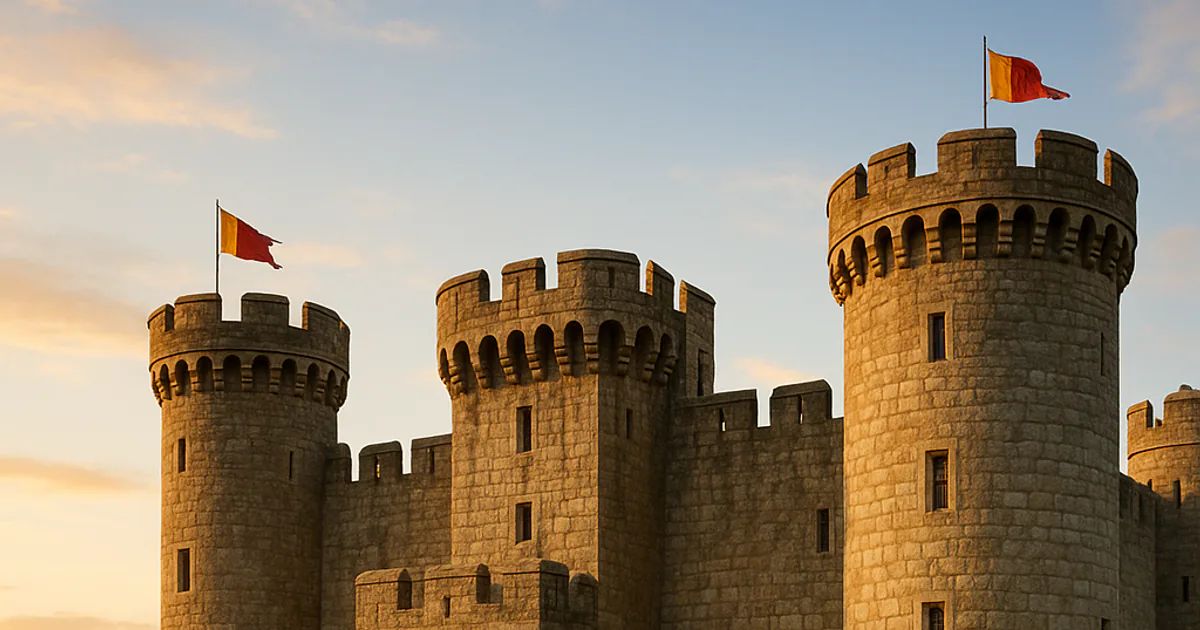
A castle is a machine for holding land, and a knight is the expensive, specialized soldier it was built to house. Start there — with the moat, the murder holes and the price of a warhorse — and medieval Europe stops being a costume drama and becomes a study of how a society organizes itself when there is no state to keep order. A castles and knights curriculum takes the interest almost every child has at some point and uses it to teach the four hundred years from the Norman Conquest to the end of the Wars of the Roses: who owned the land, who worked it, who fought for it, who prayed for everyone, and what a peasant, a lord and a monk each ate for breakfast.
It is also a genuinely cross-curricular unit. Castle design is engineering and geometry; a trebuchet is physics you can build; the feudal pyramid is civics and economics; the Bayeux Tapestry, the Magna Carta and the Domesday Book are primary sources a nine-year-old can read with help; and the literature — from Arthurian legend to Chaucer's pilgrims — is some of the best a child will meet. A six-week unit fits neatly into the world-history sequence between the ancient Rome and American Revolution guides.
A sample week
Reading & Writing
Read the Bayeux Tapestry scene by scene (the whole thing is online in high resolution), then write the story of one year — 1066 — from the point of view of a Saxon farmer, a Norman soldier and a monk keeping the chronicle.
Math
Design a castle to scale on graph paper: a curtain wall of a set perimeter, round towers spaced so every stretch of wall is covered by an archer, and a keep whose floor area is a set fraction of the bailey. Calculate the stone needed for a wall of given height and thickness.
Science
Build a tabletop trebuchet from craft sticks and a counterweight, then run a controlled test: change the counterweight mass, then the sling length, then the arm ratio, one at a time, and graph range against each.
Social Studies
Draw the feudal pyramid for a real English county using the Domesday Book's online entries — king, tenant-in-chief, knights, villeins, slaves — with the number of people at each level, then compare with a chart of who holds land today.
Art
Design a coat of arms following the real rules of heraldry (two metals, five colors, metal never on metal, color never on color), blazon it in the formal language, and paint it on a cardboard shield.
Get the 6-week planner + new unit ideas
A print-ready PDF of this castles & knights unit study — the six-week scope and sequence, grade-band notes, reading list and FAQs — plus an occasional email when a new interest guide goes up.
Adapting by grade
K-2 learners build, dress up and sort: castle parts and what each is for, who lives in a castle and what their job is, a knight's armor piece by piece. Cardboard, blocks and a good picture book carry the unit, and the vocabulary — portcullis, bailey, squire — is free.
Middle and high schoolers move into causes and sources: why castles were built and why they stopped being built, what feudalism actually was, how the Black Death broke it, and how to read a chronicle, a charter or a tapestry as evidence rather than as a story.
Activities by grade band
Grades K-2: castle parts, castle people and a cardboard keep
Young children can learn what a castle is by building one and what a knight is by dressing as one. A K-2 unit is naming the parts (moat, drawbridge, portcullis, keep, tower, wall), sorting the people (lord, lady, knight, squire, page, cook, blacksmith, priest) by what they do, and telling a story inside the building they made. The vocabulary is rich and the play is the learning.
- Cardboard castle: build a keep and a curtain wall from boxes, cut a drawbridge that raises with string, add towers from tubes, and label every part with a flag. Then decide where the well, the kitchen and the stable go and why.
- Who lives here: make a card for each castle person with a drawing and their job, and sort the cards into 'fights', 'works', 'prays' and 'rules'. Act out one day in the castle with the cards as parts.
- Knight's armor: put on the armor piece by piece — helmet, breastplate, gauntlets, greaves — from a picture book or a museum photo, using cardboard or foil, and count how many pieces a real knight wore and how long it took a squire to dress him.
- Shield and colors: choose two colors and one simple animal or shape, paint a shield, and explain what each choice means. Match six real coats of arms to the families or countries that used them from a picture card set.
Reading suggestion: The Knight and the Dragon by Tomie dePaola, a nearly wordless story that ends with a better idea than fighting, and Stephen Biesty's Cross-Sections: Castle, which shows every room and person in a working castle in astonishing detail.
Grades 3-5: how a castle worked and who did the work
Upper elementary students can understand a castle as a designed system — why it stands where it does, how each feature defeats a particular attack, how it was fed and supplied — and can begin to see medieval society as a structure with a place for everyone. This is the age for Macaulay's Castle, the first primary sources (the Bayeux Tapestry, a page of the Domesday Book) and the first diary written from inside the period.
- Read David Macaulay's Castle and build the castle it describes as a floor plan on graph paper, then write a paragraph for each of five features — the moat, the gatehouse, the arrow loops, the keep, the well — explaining what attack it was designed to stop.
- Keep a page's diary for a week in the style of Castle Diary: what a boy in training did each hour, what he ate, what he was punished for, and what he saw; then a second week as a peasant's child in the village below.
- Read the Bayeux Tapestry online from scene one to Hastings, list the events in order with the Latin captions translated, and make a five-panel embroidery or drawing of one event in the family's own year in the same style.
- Trebuchet trials: build a craft-stick trebuchet, fire a marshmallow ten times each with two different counterweights, measure every range, find the average for each, and write which weight the castle's defenders should fear more and why.
Reading suggestion: Castle by David Macaulay, the definitive illustrated account of building a Welsh castle from the first survey to the siege, and Castle Diary: The Journal of Tobias Burgess by Richard Platt, a year in the life of an eleven-year-old page.
Grades 6-8: feudalism, the Church, the plague and the sources
Middle schoolers can handle the medieval world as a system with causes: why land was held for military service, what the Church owned and controlled, how the Black Death and the longbow broke the arrangement, and how to read a chronicle, a charter or a building account as evidence with a point of view. Projects shift from models to arguments, and the trebuchet gets a proper controlled test.
- Reconstruct the feudal pyramid for one real county from the Domesday Book's online entries — who held the land from whom and how many households worked it — and write a page on what a villein owed his lord in a year and what he got in return.
- Read four clauses of Magna Carta (1215) in translation, restate each in your own words, and decide which of them still describe a right people expect today. Then find the clause about widows or the clause about fish weirs and explain why it was there.
- Model the Black Death: starting with a town of 1,000 in 1348, apply a plausible mortality rate by month from the chronicles, graph the population, and read how the labor shortage changed wages, the Statute of Labourers and the Peasants' Revolt of 1381.
- Run a full trebuchet investigation: vary counterweight, sling length and arm ratio one at a time with three trials each, graph range against each variable, and write a conclusion recommending a design for a castle-sized machine with the reasoning.
Reading suggestion: Catherine, Called Birdy by Karen Cushman, a fourteen-year-old's diary that gets the texture of a manor house right, and The Door in the Wall by Marguerite de Angeli for the plague years; for nonfiction, the DK Eyewitness Knight and Castle volumes.
Grades 9-12: medieval history from the primary sources
High schoolers can study the Middle Ages the way historians do: from chronicles, charters, building accounts, tapestries and literature, weighed against one another and against the modern arguments about what feudalism and chivalry actually were. Done with a source-based paper and a reading of a medieval text in translation, six weeks here is a substantial part of a world-history credit and a real introduction to historical method.
- Read Sir Gawain and the Green Knight in a modern translation and write an essay on what the poem thinks chivalry is, using at least three passages, then compare it with what the chronicles say knights actually did on campaign in the same century.
- Take the building accounts of one of Edward I's Welsh castles (Harlech or Conwy, summarized in Macaulay's sources and in the Castles of Wales site) and calculate the labor force, the daily wage bill and the total cost in years of a laborer's earnings; write a page on what that tells you about royal power.
- Compare two accounts of the same event — William of Poitiers and the Anglo-Saxon Chronicle on 1066, or Froissart and a town chronicle on the Peasants' Revolt — identify each author's position and audience, and write on what can be known with confidence from the two together.
- Argue the question 'Did feudalism exist?' using Ian Mortimer's Time Traveller's Guide, one chapter of Barbara Tuchman's A Distant Mirror and a summary of the historians' debate since Elizabeth Brown's 1974 article, and write a position paper with evidence from the sources.
Reading suggestion: The Time Traveller's Guide to Medieval England by Ian Mortimer, a historian's tour of the fourteenth century as a visitor would have met it, and A Distant Mirror by Barbara Tuchman for the calamitous fourteenth century in full narrative sweep.
Six-week scope and sequence
| Week | Focus | Key activity | Output |
|---|---|---|---|
| 1 | The castle | Read Macaulay's Castle; build the cardboard castle or the graph-paper plan; siting and water; every feature matched to the attack it stops; virtual tour of a real castle. | A labeled castle model or scale plan with a written explanation of five defensive features. |
| 2 | The people of the castle and the manor | Castle jobs and the feudal pyramid; the Domesday Book entries; a page's diary and a peasant's day; medieval food cooked from a period recipe. | A feudal pyramid for a real county and a week of diary entries from two points of view. |
| 3 | The knight | Armor piece by piece; training from page to squire to knight; the code of chivalry against the record; heraldry and the coat of arms. | A blazoned coat of arms on a shield and a short essay on what chivalry promised and what knights did. |
| 4 | Siege and defense | Trebuchet build and controlled trials; the arch and the buttress with blocks; a famous siege read from the chronicle; gunpowder and the end of the castle. | A trebuchet data table with graphs and a recommended design, plus a written account of one siege. |
| 5 | The wider medieval world | 1066 through the Bayeux Tapestry; Magna Carta clauses; the Crusades on a map; the Black Death modeled and its consequences; the rise of towns. | A tapestry-style panel of a real year and a graph of the plague's effect on one town with a paragraph on what followed. |
| 6 | Stories and sources | Arthurian legend or Sir Gawain; Chaucer's pilgrims for older students; compare two chronicles of one event; final siege of the castle model and a presentation or paper. | A final castle exhibit with a written or illustrated history, or a source-based paper on one medieval question. |
Standards this unit covers
- D2.His.2.3-5 (C3) — Compare life in specific historical time periods to life today — the page's and peasant's diaries against the child's own week.
- D2.Geo.2.3-5 (C3) — Use maps, satellite images, photographs and other representations to explain relationships between the locations of places and regions and their environmental characteristics — why a castle stands where it does.
- D2.His.1.6-8 (C3) — Analyze connections among events and developments in broader historical contexts — the Black Death, the labor shortage and the Peasants' Revolt.
- D2.His.4.6-8 (C3) — Analyze multiple factors that influenced the perspectives of people during different historical eras — the chronicler, the lord and the villein.
- D2.His.16.9-12 (C3) — Integrate evidence from multiple relevant historical sources and interpretations into a reasoned argument about the past — the two-chronicle comparison and the feudalism paper.
- CCSS.ELA-LITERACY.RH.6-8.6 (CCSS ELA) — Identify aspects of a text that reveal an author's point of view or purpose — reading the Bayeux Tapestry and the chronicles as Norman or Saxon accounts.
- CCSS.ELA-LITERACY.RL.9-10.9 (CCSS ELA) — Analyze how an author draws on and transforms source material in a specific work — Sir Gawain and the Arthurian tradition.
- 3-5-ETS1-3 (NGSS) — Plan and carry out fair tests in which variables are controlled and failure points are considered to identify aspects of a model or prototype that can be improved — the trebuchet trials.
- CCSS.MATH.CONTENT.4.MD.A.3 (CCSS Math) — Apply the area and perimeter formulas for rectangles in real-world and mathematical problems — the castle plan on graph paper.
Recommended books, sites and kits
- Castle by David Macaulay (Book (3-8)) — The building of a Welsh castle from survey to siege in pen-and-ink detail; the spine of the whole unit and in every library.
- The Knight and the Dragon by Tomie dePaola (Book (K-2)) — A knight and a dragon who both have to learn their jobs from books; the K-2 opener.
- Castle Diary: The Journal of Tobias Burgess by Richard Platt (Book (3-5)) — A page's year in a 1285 castle, illustrated, with notes on what is real; the model for the diary activity.
- Catherine, Called Birdy by Karen Cushman (Book (6-8)) — A Newbery Honor diary of a knight's daughter in 1290; funny, exact about daily life and honest about a girl's choices.
- The Time Traveller's Guide to Medieval England by Ian Mortimer (Book (9-12)) — A historian's guide to the fourteenth century as a visitor would find it — clothes, food, law, disease, roads; the high-school spine.
- The Bayeux Tapestry online (Bayeux Museum) (Website) — The whole 70-meter embroidery scene by scene in high resolution with translations; the primary source for 1066.
- Guédelon castle project (Website) — A full castle being built in Burgundy with thirteenth-century tools and methods since 1997, documented in photos and film; the best answer to 'how did they build it'.
- NOVA: Secrets of Lost Empires — Medieval Siege (PBS) (Video series) — Engineers build and fire two full-size trebuchets at a Scottish castle; the week-four film.
Common questions
What should a castles and knights unit study include?
Five strands: the castle itself (design, siting, siege and defense), the people of the castle and the village (feudal society, daily life, the manor and the church), the knight (training, armor, chivalry and the reality of medieval warfare), the wider medieval world (the Crusades, the Black Death, Magna Carta, the rise of towns) and the literature and art of the period. The six-week scope and sequence above runs one strand per week and ends with a castle model, a siege and a written or illustrated history the child can defend.
Which period and place does this cover?
The high and late Middle Ages in western Europe, roughly 1066 to 1485, with England and France as the spine because their castles, records and stories are the best documented and the most accessible in English. The unit opens with the Norman Conquest, when castle building arrived in England, and closes with gunpowder making stone walls obsolete. Families can widen it to the castles of Wales, Spain, the Crusader states or Japan in week six, and many do.
Is this too violent for young children?
It does not need to be. The K-2 and 3-5 bands center on how castles worked, who lived in them and what daily life was like; sieges are engineering problems and the trebuchet throws marshmallows. Battle enters through the Bayeux Tapestry, which is stylized and embroidered, and through the code of chivalry, which is a discussion about how people ought to behave. Older students meet the real thing — Agincourt, the sack of towns, the plague — with sources and context, as they should.
Do we need to visit a castle?
No, though if one is within reach it is worth the trip; several North American museums also have full suits of armor and castle models. The unit uses the virtual tours, floor plans and reconstructions that the best castle sites publish free, the Bayeux Tapestry online, and the Guédelon project in France, where a full castle is being built by hand with medieval methods and filmed doing it. A cardboard castle in the living room teaches the design better than a walk through a ruin.
How does this connect to math and science?
Castle design is geometry and measurement: perimeter, area, angles of fire from a tower, the volume of stone in a wall. The trebuchet is a lever and a projectile, and testing it is a controlled experiment. Medieval builders solved real load problems — the arch, the buttress, the vault — that a child can model with blocks and paper. Older students can estimate a castle's cost in labor and materials from the surviving building accounts of Edward I's Welsh castles, which list wages and quantities week by week.
Can I run this with several ages at once?
Yes. Everyone builds the same castle, fires the same trebuchet and looks at the same tapestry; the output changes by age. A six-year-old labels the parts of the castle, a ten-year-old writes the day of a page and a peasant, a thirteen-year-old explains why the castle is where it is and how it fell, and a sixteen-year-old reads the chronicle and argues about what feudalism was. The grade-band sections above are written so you can pick one row per child from one week.
Does this unit work for secular and faith-based homeschools alike?
Yes. The Church is central to medieval Europe — monasteries kept the records, cathedrals were the great engineering projects, and religion shaped the Crusades and daily life — and this unit teaches that history with sources and lets families frame it as they choose. Nothing here requires a particular view of the period's faith; secular families teach the Church as an institution of the age and faith-based families teach it in their own tradition, using the same chronicles, buildings and art.
How much does a castles and knights unit study cost?
Almost nothing. Cardboard boxes, craft sticks, rubber bands, string and a hot-glue gun cover the castle and the trebuchet; paint and a cardboard shield cover the heraldry. The books are library titles — Macaulay's Castle is in nearly every library system — and every website on the resource list is free. A visit to a museum arms-and-armor gallery is the one optional expense.
Related curriculum ideas
 Ancient Rome homeschool curriculum
An ancient Rome homeschool curriculum for K-12 — the Republic and Empire, roads and aqueducts, Latin, daily life and the fall of Rome through reading, geography, math and art.
 Mythology homeschool curriculum
Build a homeschool curriculum around mythology — Greek, Norse and world myths carrying literature, history, geography and art for K-12.
 LEGO & Building homeschool curriculum
A homeschool curriculum built on LEGO — engineering, math, storytelling and design thinking through building, for K-12 learners.
Turn this into a full curriculum
Generate a complete, standards-aligned curriculum around this interest in minutes — free to try, no account required.