Human body homeschool curriculum: anatomy unit study for K-12
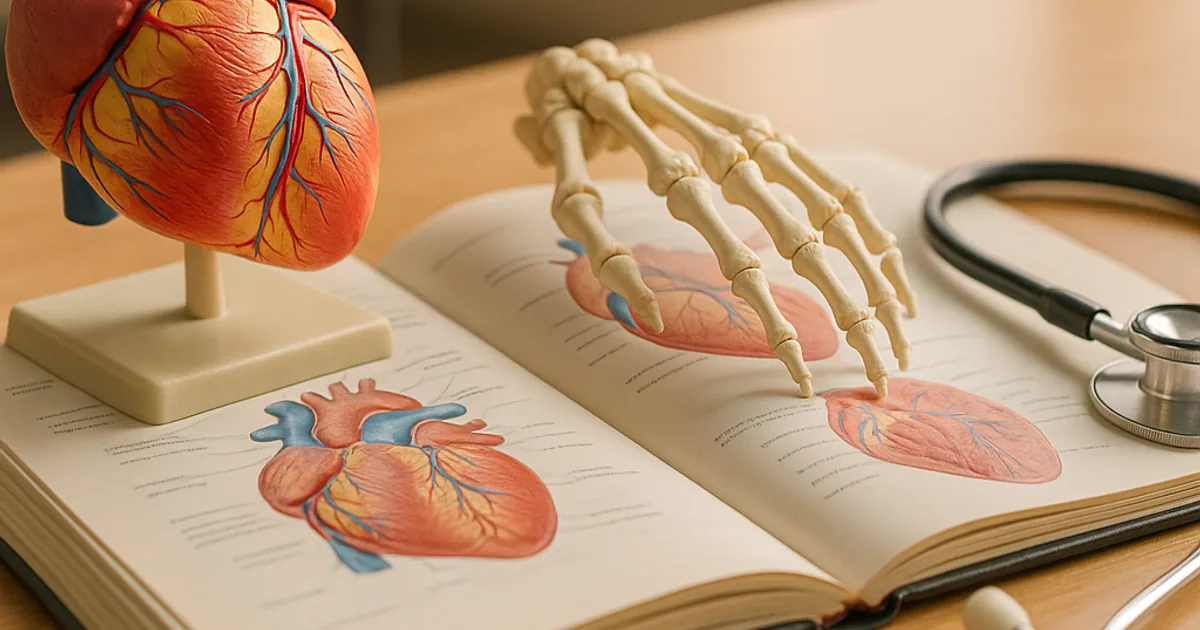
Every child owns the best laboratory for this unit and carries it everywhere. A human body curriculum uses that: pulse counted at the wrist before and after running, lung capacity measured into a balloon, a chicken wing dissected to see how tendons pull on bone. The subject is anatomy and physiology, but the method is measurement, comparison and explanation — which is what science looks like at every grade.
It is also unusually good at carrying the other subjects. Nutrition labels are ratio and percentage practice; the history of medicine — Harvey and the circulation of blood, Jenner and the first vaccine, the discovery of germs — is a chapter of world history most curricula skip; and the writing prompts are endless because the student is the subject. A six-week human body unit study fits comfortably inside a life-science or health credit at any level.
A sample week
Reading & Writing
Read a short account of William Harvey proving that blood circulates, then write a first-person 'day in the life of a red blood cell' that gets the route right: heart, lungs, heart, body, back.
Math
Count resting pulse for fifteen seconds and multiply by four, then repeat after one minute of jumping jacks and after five minutes of rest. Graph the three readings and calculate how many times the heart beats in a day at rest.
Science
Dissect a raw chicken wing from the grocery store: find the skin, muscle, tendons, bone and joint, pull a tendon to make the wing bend, and label a drawing of what did what.
Social Studies
Trace how one disease changed history — smallpox, the 1918 flu or the Black Death — and mark on a map where it went, then read how the response (quarantine, vaccination, sanitation) was invented.
Art
Draw a life-size body outline on butcher paper and place the major organs in the right spot at the right size, using a reference; older students add the skeleton on the other side.
Get the 6-week planner + new unit ideas
A print-ready PDF of this human body unit study — the six-week scope and sequence, grade-band notes, reading list and FAQs — plus an occasional email when a new interest guide goes up.
Adapting by grade
K-2 learners work with what they can feel and see: bones under the skin, a heartbeat, breathing in and out, the five senses, and the basics of staying healthy. Keep the real names — femur, skull, lungs — because they are free vocabulary.
Middle and high schoolers move into systems that interact: how the circulatory and respiratory systems cooperate, what homeostasis means when you sweat or shiver, and how to read a real study about sleep or nutrition without being fooled by the headline.
Activities by grade band
Grades K-2: bones, breath, heartbeat and senses
Young children can feel their own skeleton, hear their own heart and watch their own chest rise, which makes the body the most concrete science topic there is. A K-2 human body unit is observation, naming, counting and simple cause and effect: run, and the heart goes faster. Keep the anatomical names; a five-year-old who says 'femur' has decoded a new word and learned a fact at once.
- Bone hunt: feel and name ten bones on your own body — skull, jaw, collarbone, ribs, spine, hip, femur, kneecap, shin, the small bones of the hand — and stick a label on a life-size body outline for each one. Count how many bones you found and how many an adult has (206).
- Heartbeat listening: use a stethoscope or a cardboard tube on a family member's chest, count beats for fifteen seconds while resting, then after twenty jumping jacks, and draw two hearts — a slow one and a fast one — with the numbers written inside.
- Five-senses stations: a blindfold taste test (sweet, salty, sour), a mystery bag of textures, a smell jar line-up, a whisper-distance test and an eye chart across the room. Record which sense gave the right answer each time.
- Lung balloon: take the biggest breath you can and blow into a balloon, then measure its width with a string and compare with a parent's. Talk about why the parent's is bigger and what the lungs do with the air.
Reading suggestion: Me and My Amazing Body by Joan Sweeney, a first-person tour of skin, bones, muscles, blood and brain for the youngest readers, and The Magic School Bus Inside the Human Body by Joanna Cole for a ride through digestion and circulation.
Grades 3-5: systems, structures and real measurements
Upper elementary students can move from parts to systems: what the skeleton, muscles, heart, lungs and digestive tract each do and how they depend on one another. This is the age for hands-on models and real data — pulse recovery graphs, reaction-time trials, a chicken wing dissection — and for the first history of medicine: Harvey, Jenner and the discovery that washing hands saves lives.
- Dissect a raw chicken wing: peel back the skin, find the muscles on each side of the bone, pull a tendon and watch the wing bend, then cut into the joint to see the cartilage. Draw and label it, and write three sentences on how a muscle moves a bone.
- Build a working lung model from a plastic bottle, two balloons and a straw (the bottom balloon is the diaphragm) and explain in writing why pulling the diaphragm down makes air go in. Then measure your own lung capacity by blowing into a balloon and calculating its volume from its diameter.
- Run a reaction-time experiment: a partner drops a ruler between your fingers and you catch it; convert the catch distance to time with a chart, take ten trials, find the average, and test whether it changes with your other hand or with your eyes on a screen first.
- Trace a bite of apple from mouth to exit on a diagram, labeling each organ and what it does, then time how long a cracker takes to taste sweet in your mouth — the enzyme amylase turning starch to sugar — and explain what that shows.
Reading suggestion: The Way We Work by David Macaulay, the same illustrator's approach as The Way Things Work turned on the body, and the National Geographic Kids Ultimate Bodypedia for a system-by-system reference to keep open all unit.
Grades 6-8: interacting systems and homeostasis
Middle schoolers can handle the body as a set of interacting subsystems that keep conditions steady — the NGSS framing — and can read real evidence about sleep, exercise and nutrition. Labs move from models to controlled measurements, and the writing shifts to explaining mechanisms: not just that the heart speeds up during exercise, but why, and how it knows to.
- Design a controlled exercise study: measure resting heart rate and breathing rate, then after two, four and six minutes of steady exercise, and again every minute during recovery. Graph both on the same axes and write an explanation that links heart rate, breathing rate and the muscles' demand for oxygen.
- Dissect a sheep or beef heart (a butcher or a biological supply company): identify the four chambers, the valves and the thick left ventricle wall, then explain why the left side is stronger in terms of where each side has to pump blood.
- Read a nutrition label from five foods, calculate the percentage of calories from fat, carbohydrate and protein for each, and compare with published dietary guidance. Then write a one-page argument about which label is the most misleading and why.
- Model homeostasis: measure skin temperature with a thermometer before and after holding a hand in cold water, and after exercise, and write out the feedback loop — receptor, control center, response — that brought the temperature back.
Reading suggestion: Human Body: A Visual Encyclopedia from DK for the reference spine, and selected chapters of Bill Bryson's The Body: A Guide for Occupants — the heart, lungs and immune-system chapters read aloud well and are full of numbers worth checking.
Grades 9-12: anatomy and physiology as a lab science
High schoolers can run this as the opening unit of an anatomy and physiology or biology course: hierarchical organization from cell to organism, feedback mechanisms, quantitative labs with written reports and the reading of primary research. Done at this depth with a portfolio of lab reports, the six weeks are a legitimate part of a lab-science credit.
- Complete a full lab report on cardiovascular response to exercise: hypothesis, method (heart rate, blood pressure with an inexpensive cuff, recovery time), data table, graph, and a discussion that uses stroke volume and cardiac output correctly. Compare your recovery curve with published values for trained athletes.
- Carry out a comparative dissection — a fetal pig or a preserved frog from a biological supply company, or a whole fish from a seafood counter — and produce labeled diagrams of the digestive, circulatory and respiratory systems with a written comparison to the human versions.
- Read the abstract and results of a recent open-access study on sleep and memory or on exercise and mood (PLOS ONE and PubMed Central publish many), summarize the design and the effect size, and write a page on what the study can and cannot claim.
- Build a spreadsheet model of blood glucose regulation: a starting level, a meal that raises it, insulin that lowers it in proportion, and glucagon that raises it when low. Vary the insulin response to model type 1 and type 2 diabetes and describe the curves in a short report.
Reading suggestion: The Body: A Guide for Occupants by Bill Bryson as the narrative spine, paired with the free OpenStax Anatomy and Physiology textbook for the chapter-level detail and end-of-chapter questions a credit needs.
Six-week scope and sequence
| Week | Focus | Key activity | Output |
|---|---|---|---|
| 1 | The skeleton and muscles | Bone hunt and life-size body outline; chicken wing dissection to see how muscles pull on bones across a joint. | A labeled body outline and a dissection drawing with a written explanation of how a joint moves. |
| 2 | The heart and circulation | Pulse measurements at rest, during and after exercise; heart model or sheep heart dissection; read Harvey's discovery of circulation. | A pulse graph with an interpretation and a labeled heart diagram. |
| 3 | Lungs and breathing | Bottle-and-balloon lung model; lung capacity by balloon; breathing rate against exercise; how oxygen gets to the blood. | A working model with a written explanation and a capacity measurement compared across the family. |
| 4 | Digestion and nutrition | Trace food through the digestive tract; cracker amylase test; nutrition label math; older students model blood sugar. | A digestive tract diagram, a label-comparison table and a paragraph on one real food decision. |
| 5 | Brain, nerves and senses | Reaction-time trials, five-senses stations, reflex tests; older students study the feedback loops of homeostasis. | A reaction-time data table with averages and a written explanation of the pathway from eye to hand. |
| 6 | Systems together and the history of medicine | Read about Jenner, Semmelweis or Pasteur; map a historical epidemic; present the unit as a body-systems exhibit or lab portfolio. | A final exhibit, illustrated report or lab portfolio showing how the systems interact. |
Standards this unit covers
- 4-LS1-1 (NGSS) — Construct an argument that plants and animals have internal and external structures that function to support survival, growth, behavior and reproduction — the skeleton, muscle and organ strand.
- 4-LS1-2 (NGSS) — Use a model to describe that animals receive different types of information through their senses, process the information in their brain and respond to it in different ways — the senses and reaction-time work.
- MS-LS1-3 (NGSS) — Use argument supported by evidence for how the body is a system of interacting subsystems composed of groups of cells.
- MS-LS1-8 (NGSS) — Gather and synthesize information that sensory receptors respond to stimuli by sending messages to the brain for immediate behavior or storage as memories.
- HS-LS1-2 (NGSS) — Develop and use a model to illustrate the hierarchical organization of interacting systems that provide specific functions within multicellular organisms.
- HS-LS1-3 (NGSS) — Plan and conduct an investigation to provide evidence that feedback mechanisms maintain homeostasis — the exercise, temperature and blood-sugar labs.
- CCSS.MATH.CONTENT.6.SP.B.5 (CCSS Math) — Summarize numerical data sets in relation to their context — the pulse, reaction-time and lung-capacity data.
- CCSS.ELA-LITERACY.RST.6-8.3 (CCSS ELA) — Follow precisely a multistep procedure when carrying out experiments, taking measurements or performing technical tasks — every lab in the unit.
Recommended books, sites and kits
- Me and My Amazing Body by Joan Sweeney (Book (K-2)) — A child narrates a tour of her own skin, bones, muscles, heart and brain; the read-aloud for week one.
- The Way We Work by David Macaulay (Book (3-8)) — The Way Things Work illustrator on the body; dense, funny and accurate, and a reference a fourth grader can browse alone.
- Human Body: A Visual Encyclopedia (DK) (Book (3-8)) — System-by-system spreads with cutaway illustrations; the shelf reference for the whole unit.
- The Body: A Guide for Occupants by Bill Bryson (Book (9-12)) — A narrative tour of anatomy, physiology and the history of medicine; the high-school reading spine and a strong middle-school read-aloud.
- OpenStax Anatomy and Physiology (Website) — A free, peer-reviewed college-level textbook with chapter questions; the detail source for a high-school credit.
- KidsHealth (Nemours) (Website) — Free, medically reviewed explanations of every body system written at three reading levels — child, teen and parent.
- Crash Course Anatomy & Physiology (Video series) — Forty-seven short episodes covering each system at high-school depth; one or two per week map onto the scope and sequence.
- Preserved sheep heart or fetal pig (Carolina Biological or Home Science Tools) (Kit) — Inexpensive specimens with dissection guides; the week-two heart and the 9-12 comparative dissection.
Common questions
What should a human body unit study include?
A complete human body unit study covers the major systems — skeletal, muscular, circulatory, respiratory, digestive, nervous — plus how they work together, a health and nutrition strand, and a history-of-medicine thread for reading and writing. The six-week scope and sequence above takes one or two systems per week and ends with a project that shows the systems as a whole. The important thing is measurement: pulse, breaths, reaction time, lung volume. A body unit with no data is just vocabulary.
How do I teach anatomy without a lab or a cadaver?
The grocery store is the lab. A chicken wing shows muscle, tendon, bone and a hinge joint; a whole fish shows gills, a heart and a spine; a beef or lamb heart from a butcher, or a preserved sheep heart from a biological supply company, shows four chambers and valves for a few dollars. Add a stethoscope, a tape measure and balloons for lung capacity and you have every lab in this guide.
Does this work for a squeamish child?
Yes. Every hands-on activity has a non-dissection version: the chicken wing can be replaced with a cardboard-and-rubber-band model of a joint, the heart with a pump made from a jar, balloons and straws. Many children who refuse the wing in week two ask to do it by week five once the diagrams have made it familiar. Follow the child; nothing here depends on the dissection.
Can I run this with several ages at once?
It is one of the easiest units for that. Everyone measures the same pulse and dissects the same wing; the output changes by age. A six-year-old labels the bones she can feel, a ten-year-old graphs the family's pulse recovery times, and a fourteen-year-old explains the graph in terms of stroke volume and oxygen demand. The grade-band sections above are written so you can pick one row per child from the same week.
How much science does a human body unit count for?
At the elementary level it covers the life-science strand of the year — structures and functions, senses, what living things need. In middle school it maps directly onto the NGSS body-systems standards listed above. For high school, a six-week unit with lab reports is a substantial slice of a biology or a health credit; a full anatomy and physiology credit needs a textbook spine and roughly 120 hours, with this unit as the opening third.
How do we handle puberty and reproduction?
That is your call and your timing. This guide covers the systems every family teaches — skeleton, muscles, heart, lungs, digestion, brain and senses — and leaves the reproductive system for you to add at the depth and age you choose. The grade-band activities and the scope and sequence stand on their own without it.
Does this unit work for secular and faith-based homeschools alike?
Yes. The content is anatomy, physiology and the history of medicine, taught through observation and measurement. Nothing in it depends on a particular worldview, and families who teach the body as a creation and families who teach it as a product of evolution use the same pulse data, the same chicken wing and the same reading list. Where a book on the list touches origins, it is noted so you can choose.
How much does a human body unit study cost to put together?
Under twenty dollars if you use the library. The consumables are a chicken wing, balloons, straws, a ruler, string, food coloring and a stethoscope (inexpensive online). A sheep heart or an owl pellet kit is an optional extra. Every website on the resource list is free, and the reading spine is one library book per grade band.
Related curriculum ideas
 Animals & Wildlife homeschool curriculum
A homeschool curriculum built around animals — zoology, habitats, and conservation woven through reading, math, science and geography for K-12.
 Cooking & Baking homeschool curriculum
The kitchen as classroom — fractions, chemistry, world geography and budgeting through a cooking-centered homeschool curriculum, K-12.
 Insects & Bugs homeschool curriculum
An insect homeschool curriculum for K-12 — life cycles, entomology, pollination and ecology taught through backyard fieldwork, reading, math and art, with a six-week plan.
Turn this into a full curriculum
Generate a complete, standards-aligned curriculum around this interest in minutes — free to try, no account required.