Bees and butterflies homeschool curriculum: pollinator unit study for K-12
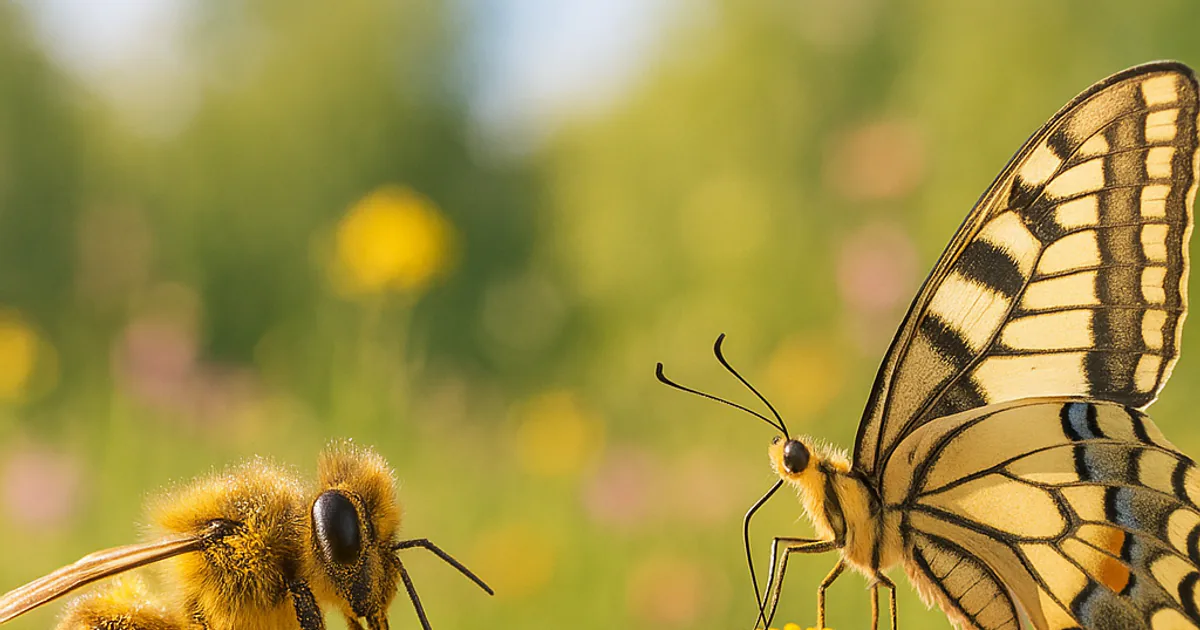
Roughly one bite in three of what a family eats depends on a pollinator, which makes bees and butterflies one of the few science topics that connects directly to the dinner table. A pollinator curriculum starts in the nearest flower bed — counting who visits a patch of clover in ten minutes, watching a bee pack pollen onto her back legs, finding a monarch egg the size of a pinhead under a milkweed leaf — and grows into a study of life cycles, plant reproduction, animal navigation and the economics of an entire food system.
The two animals make a good pair because they teach different things. Butterflies give the clearest life cycle in nature and a migration measured in thousands of miles; honeybees give a social animal with a language, a division of labor and a product people have traded for five thousand years. Together they carry six weeks of science, and the reading, math and history come without stretching: honey in ancient Egypt, the waggle dance decoded by a Nobel laureate, and the arithmetic of a hive that visits two million flowers for one pound of honey. This guide is the pollinator-focused companion to the broader insects unit study.
A sample week
Reading & Writing
Read how Karl von Frisch worked out that a honeybee's waggle dance points to food, then write a set of instructions for a partner in 'bee language' — direction and distance only, no words — and test whether they can find the hidden object.
Math
Sit beside one flowering plant for three ten-minute counts at different times of day, tally every visitor by type (honeybee, bumblebee, butterfly, fly, other), and graph the results. Older students convert the count to visits per flower per hour and estimate a full day.
Science
Raise painted lady caterpillars from a kit or find a monarch caterpillar on milkweed, measure it daily, record the day each stage begins, and photograph the chrysalis the hour before the butterfly emerges.
Social Studies
Map the monarch's fall migration from southern Canada to the oyamel fir forests of central Mexico, mark the distance in miles, and read how the wintering grounds were only found by scientists in 1975.
Art
Draw a flower in cross-section with the pollinator that fits it — a long-tongued butterfly on a tubular flower, a bee on an open daisy — labeling petal, stamen, pistil and nectar, then paint the ultraviolet 'nectar guide' pattern bees can see and we cannot.
Get the 6-week planner + new unit ideas
A print-ready PDF of this bees & butterflies unit study — the six-week scope and sequence, grade-band notes, reading list and FAQs — plus an occasional email when a new interest guide goes up.
Adapting by grade
K-2 learners can find and name pollinators, act out the butterfly life cycle, watch a bee carry pollen and plant the flowers that feed both. Fear of stings is the first thing to address; a child who has watched a foraging bee ignore her for five minutes stops flinching.
Middle and high schoolers move into mechanisms and evidence: how flower structure and pollinator behavior co-evolved, how a hive decides where to swarm, what the data on colony losses and monarch counts actually show, and how to design a habitat experiment with a control.
Activities by grade band
Grades K-2: watching, counting and the four stages
Young children can learn what a pollinator does by watching one do it, and the butterfly life cycle is the first piece of biology most of them master completely. A K-2 pollinator unit is looking closely, counting, naming the stages, and planting something that brings the animals back. The safety lesson — watch with your eyes, keep your hands still — is part of the science.
- Flower stakeout: sit by one flowering plant for five minutes with a clipboard and make a tally mark for every visitor, then draw the one that stayed longest. Do it again in the afternoon and compare the two counts.
- Raise painted lady caterpillars: measure each one against a ruler every morning, draw the chrysalis on the day it forms, count the days until the butterfly, and release the adults together in the garden.
- Pollen on purpose: dip a cotton swab in cornmeal 'pollen', visit five paper flowers the way a bee would, and see how much travels from flower to flower. Then find a real bee and watch for the yellow lumps on its back legs.
- Plant a pollinator pot: sow zinnia, cosmos or sunflower seeds in a large pot or a corner of the yard, water and measure the plants weekly, and keep a list of who visits once they bloom.
Reading suggestion: The Honeybee by Kirsten Hall, a rhyming picture book that follows one bee from flower to hive, and Monarch Butterfly by Gail Gibbons for the life cycle and migration in clear pictures and plain words.
Grades 3-5: life cycles, flower parts and the hive
Upper elementary students can hold the whole system: what a flower is for, how a pollinator carries pollen without meaning to, how a honeybee colony divides its work by age, and how a monarch that has never made the trip finds a forest in Mexico. This is the age for dissecting a flower, keeping real data on visitors and reading the first true stories of the scientists who worked it out.
- Dissect a large flower — a lily, tulip or hibiscus — with tweezers, separate and label petals, sepals, stamens (anther and filament), pistil (stigma, style, ovary), tape each part to a card, then touch the anther to a finger and find the pollen. Slice the ovary to find the future seeds.
- Run a three-day visitor census on two different plants, recording each visit by pollinator type, time and how long it stayed. Make a bar graph for each plant and write three sentences on which plant was more popular and one reason why.
- Build a paper honeybee colony: cut out and label the jobs a worker holds in order across her six-week life — cell cleaner, nurse, wax builder, guard, forager — and calculate how many bees a hive of 50,000 needs in each job if it keeps the usual proportions.
- Track the monarch migration on a map with Journey North's reports, marking where sightings are each week in fall, and calculate how many miles the butterflies cover in a week and how many days the trip to Mexico takes.
Reading suggestion: The Honey Makers by Gail Gibbons for the colony and the beekeeper's year, and Bees: A Honeyed History by Piotr Socha, an oversized illustrated book on bee biology, beekeeping and honey across five thousand years that a fourth grader will read cover to cover.
Grades 6-8: co-evolution, communication and real data
Middle schoolers can move from watching to explaining: why a flower's shape, color and scent match its pollinator, how the waggle dance encodes direction and distance, and what the published numbers on monarch counts and colony losses show. The work shifts toward designed experiments, evidence-based argument and reading a scientific source with a critical eye.
- Test flower color preference: set out identical dishes of sugar water on blue, yellow, white and red paper in a sunny spot, count visits by type over three thirty-minute sessions, rotate the positions between sessions to control for location, and write up the result with a graph and a limitation.
- Decode the waggle dance: watch slow-motion footage of a dancing bee, measure the angle of the waggle run from vertical and its duration, and use von Frisch's rules (angle from the sun, roughly one second per kilometer) to draw where the food is on a map of the hive's surroundings.
- Analyze the monarch overwintering data: graph the annual area of forest occupied in Mexico from the published series (Monarch Watch and WWF Mexico report it in hectares each winter), identify the low years, and write a page on two proposed causes and what evidence would separate them.
- Design a pollinator habitat plot: measure a plot, choose native plants that bloom in three seasons using the Xerces Society regional lists, draw the plan to scale, price it, and plant at least part of it.
Reading suggestion: Flight of the Honey Bee by Raymond Huber, a narrative nonfiction picture book that reads well at this level for the scout bee's day, paired with chapters of The Bee Book by Charlotte Milner and, for the strongest readers, the opening of Honeybee Democracy by Thomas Seeley.
Grades 9-12: ecology, economics and a research question
High schoolers can treat pollinators as a research field: the co-evolution of flowering plants and insects, the collective decision-making of a swarm, the causes of pollinator decline, and the economics of crop pollination. Done with a formal habitat study and a source-based paper, six weeks here is a legitimate slice of a biology or environmental-science credit.
- Run a formal pollinator transect: walk a fixed 50-meter line through a meadow, garden or park edge three times a week at the same hour, record every pollinator within one meter by group, and compare two habitats statistically (mean visits per walk, with a simple t-test or a clearly reasoned comparison of ranges).
- Read Seeley's account of how a swarm chooses a new home and write a two-page explanation of the decision process — scouts, dances, quorum sensing — and what it has in common with how groups of people reach consensus.
- Investigate one proposed driver of pollinator decline (neonicotinoid pesticides, Varroa mites, habitat loss, climate shifts in bloom timing) using at least two peer-reviewed sources found through PubMed Central or Google Scholar, and write a source-based argument on the strength of the evidence.
- Model the economics of pollination: using published figures for almond pollination in California (hives per acre, rental fee per hive, acres in production), calculate the size of the annual pollination market and write on what happens to the price of almonds if hive numbers fall by a fifth.
Reading suggestion: Honeybee Democracy by Thomas Seeley, a working scientist's account of how a swarm makes a decision, and Four Wings and a Prayer by Sue Halpern on the science and the people behind the monarch migration.
Six-week scope and sequence
| Week | Focus | Key activity | Output |
|---|---|---|---|
| 1 | Meet the pollinators | Flower stakeout counts at two times of day; sort visitors into bees, butterflies, flies and others; start the painted lady kit or find a monarch caterpillar. | A tally sheet with a bar graph and a labeled drawing of the most common visitor. |
| 2 | How pollination works | Dissect a flower and label its parts; cornmeal pollen transfer; flower color preference experiment for older students; the ultraviolet nectar-guide painting. | A mounted, labeled flower dissection and a written explanation of how pollen gets from one flower to the next. |
| 3 | The honeybee colony | The worker's life by age; the waggle dance decoded; honey tasting from three sources; hive visit or beekeeper video; how much foraging one jar represents. | A colony job chart with the arithmetic of a 50,000-bee hive and a paragraph on the waggle dance. |
| 4 | The butterfly life cycle and the monarch migration | Daily caterpillar measurements and the chrysalis; migration mapping with Journey North; miles per week calculations; how the wintering grounds were found. | A life-cycle log with dates and measurements and a migration map with distances. |
| 5 | Pollinators and people | Honey in ancient Egypt and the medieval beekeeper; crop pollination economics; the evidence on pollinator decline; a source-based argument for older students. | A timeline of honey and beekeeping or a one-page argument on a cause of pollinator decline. |
| 6 | Build a habitat | Design and plant a pollinator garden or pot with three-season bloom; older students run a transect and present their data; release the butterflies. | A scale plan of the planting with a plant list, and a final presentation, field guide or research report. |
Standards this unit covers
- K-LS1-1 (NGSS) — Use observations to describe patterns of what plants and animals (including humans) need to survive — what a pollinator gets from a flower and the flower from the pollinator.
- 2-LS2-2 (NGSS) — Develop a simple model that mimics the function of an animal in dispersing seeds or pollinating plants — the cornmeal pollen transfer and the paper-flower bee.
- 3-LS1-1 (NGSS) — Develop models to describe that organisms have unique and diverse life cycles but all have in common birth, growth, reproduction and death — the raised butterfly log.
- MS-LS1-4 (NGSS) — Use argument based on empirical evidence and scientific reasoning to support an explanation for how characteristic animal behaviors and specialized plant structures affect the probability of successful reproduction — flower structure and pollinator behavior.
- MS-LS2-5 (NGSS) — Evaluate competing design solutions for maintaining biodiversity and ecosystem services — the pollinator habitat plot.
- HS-LS2-7 (NGSS) — Design, evaluate and refine a solution for reducing the impacts of human activities on the environment and biodiversity — the transect study and the pollinator-decline argument.
- CCSS.MATH.CONTENT.3.MD.B.3 (CCSS Math) — Draw a scaled picture graph and a scaled bar graph to represent a data set with several categories — the flower visitor counts.
- CCSS.ELA-LITERACY.W.6.1 (CCSS ELA) — Write arguments to support claims with clear reasons and relevant evidence — the pollinator-decline and flower-preference write-ups.
Recommended books, sites and kits
- The Honeybee by Kirsten Hall (Book (K-2)) — A rhythmic read-aloud that follows one bee from a flower back to the hive; the week-one opener.
- Monarch Butterfly by Gail Gibbons (Book (K-2)) — The life cycle and the migration in the clear, labeled pictures Gibbons is known for; pairs with the caterpillar log.
- Bees: A Honeyed History by Piotr Socha (Book (3-5)) — An oversized illustrated survey of bee anatomy, hive life, beekeeping and honey through history; the browse-alone book for the unit.
- Honeybee Democracy by Thomas Seeley (Book (9-12)) — How a swarm chooses a home, by the scientist who worked it out; the high-school reading spine and a source for the 6-8 waggle dance week.
- Journey North (Website) — A free citizen-science project that maps monarch sightings across North America every week of the migration; the week-four mapping source.
- Xerces Society for Invertebrate Conservation (Website) — Free regional native-plant lists, habitat guides and the evidence summaries on pollinator decline used in weeks five and six.
- Painted lady butterfly kit (Insect Lore or similar) (Kit) — Live caterpillars, food and a mesh habitat; the full life cycle in about three weeks, any season.
- Wings of Life (Disneynature) (Video series) — A feature-length documentary on pollinators with macro footage of bees, butterflies, bats and hummingbirds at work; the best single hour of film for the unit.
Common questions
What should a bees and butterflies unit study include?
Five strands: the pollinator's body and life cycle (complete metamorphosis in both animals), how pollination works and why flowers look the way they do, the honeybee colony as a society, the monarch migration as a case study in navigation and conservation, and the human side — honey, beekeeping, crop pollination and the decline of pollinators. The six-week scope and sequence above takes them roughly in that order and ends with a pollinator garden or a research report the child can defend.
How is this different from your insects unit study?
The insects guide covers the whole class — body plan, classification across orders, beetles, ants, crickets, decomposers and pests. This guide takes the two pollinators nearly every child already loves and goes deep: hive society, the waggle dance, migration, flower structure and the food-system economics that insects in general do not raise. Families often run this one first and the insects unit the following season, or use the two as a spring and fall pair.
Are we going to get stung?
Almost certainly not. Foraging honeybees and bumblebees on flowers are focused on nectar and sting only when trapped or squashed; the stings children get are usually from stepping on a bee barefoot in clover or from wasps at a picnic. The rule for this unit is watch, do not grab, and wear shoes. A child with a known bee allergy can do every activity from the butterfly and flower side, with the bee work done through video and a windowpane.
Do we need a beehive or a butterfly house?
No. A patch of flowers, a magnifying glass and a notebook are the lab. A painted lady kit gives the butterfly life cycle in three weeks for about the price of a pizza. If a local beekeeper or nature center offers a hive visit, take it in week three; many beekeeping associations run open days and welcome children in loaner veils. Keeping a hive yourselves is a wonderful year-long project but a separate one.
When is the best time of year to run this unit?
Late spring through early fall, when flowers are open and pollinators are working. Monarch caterpillars are on milkweed from late spring into September in most of North America, and the fall migration is visible from August to October. In winter the unit still works with a painted lady kit, the reading, the migration mapping and a garden plan to plant in spring; several of the citizen-science projects on the resource list also run year-round.
Can I run this with several ages at once?
Yes, and it is one of the best units for it because the observation is shared. Everyone sits by the same flower and raises the same caterpillars. A kindergartner counts and draws the visitors, a fourth grader graphs them by type and time of day, a seventh grader compares two plants and tests a hypothesis about color or shape, and a tenth grader turns the same counts into a habitat assessment with a written method. The grade-band sections above are written so you can pick one row per child from one week.
Does this unit work for secular and faith-based homeschools alike?
Yes. The content is observation, life cycles, plant reproduction, animal behavior and ecology, and the activities are the same in either setting. Where the 6-8 and 9-12 reading touches co-evolution — how flower shapes and pollinator bodies came to match — it is noted so you can frame it as adaptation, design or natural selection according to your family's convictions. The counts, the caterpillars and the garden are the same either way.
How much does a bees and butterflies unit study cost?
Under thirty dollars. A painted lady kit with live caterpillars is roughly twenty to thirty dollars; a packet of milkweed and wildflower seeds is a few dollars; a magnifying glass and a notebook you likely have. Honey for the tasting is the grocery budget. Every website and citizen-science project on the resource list is free, and the reading spine is one library book per grade band.
Related curriculum ideas
 Insects & Bugs homeschool curriculum
An insect homeschool curriculum for K-12 — life cycles, entomology, pollination and ecology taught through backyard fieldwork, reading, math and art, with a six-week plan.
 Gardening & Plants homeschool curriculum
A homeschool curriculum grown in the garden — botany, ecology, math and patience through growing food and plants, for K-12 learners.
 Birds & Birdwatching homeschool curriculum
A homeschool curriculum built around birds — identification, migration, ecology and citizen science you can do from the window, for K-12.
Turn this into a full curriculum
Generate a complete, standards-aligned curriculum around this interest in minutes — free to try, no account required.