Baking homeschool curriculum: kitchen math and chemistry unit study for K-12
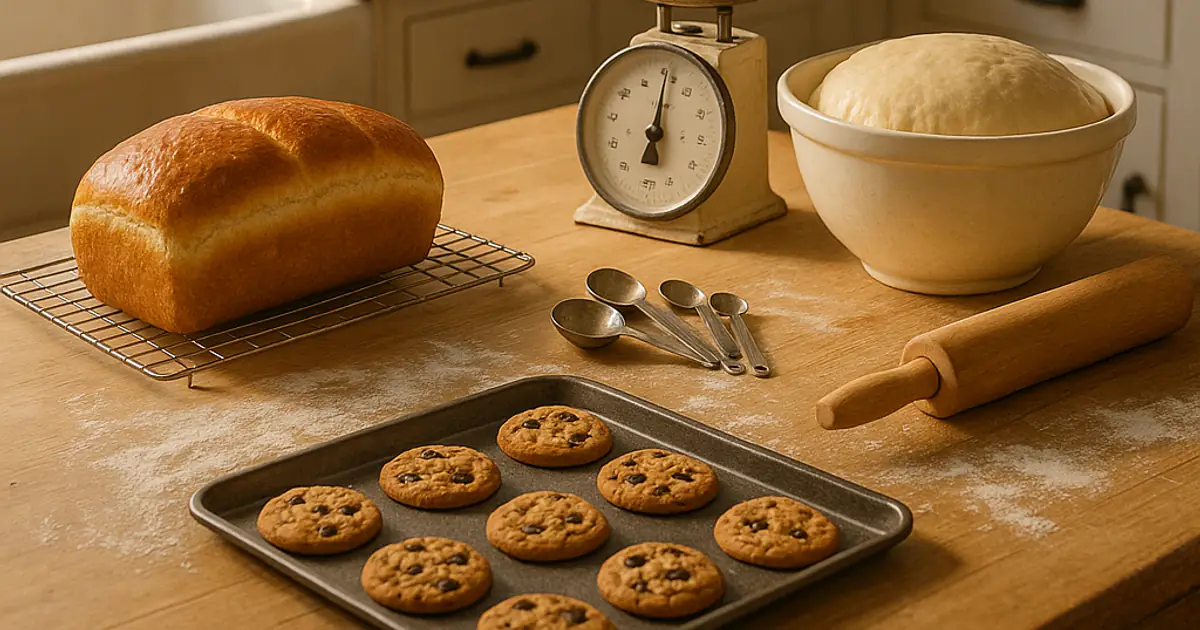
Baking is the most precise thing most families do in a kitchen, which is exactly why it teaches so well. A cake is a ratio, a loaf of bread is a controlled fermentation, and a cookie that spreads into a puddle is a failed experiment with a findable cause. A baking curriculum takes the child who already wants to make brownies and turns the wanting into measurement, fractions, chemistry and the habit of changing one thing at a time to see what happens. The results are checked by eating them, which is the most motivating assessment there is.
This guide is narrower and deeper than our broader cooking unit study. Cooking ranges across cuisines, geography and budgeting; baking stays with flour, water, fat, sugar, eggs and leavening and asks what each one does. That focus is what makes it a math and science unit: doubling and halving recipes is fraction arithmetic with consequences, baker's percentages are ratio and proportion in daily professional use, and yeast, baking soda, gluten and the browning of a crust are four real chemistry lessons that happen to smell wonderful.
A sample week
Reading & Writing
Read how a nineteenth-century baker's recipe was written — 'butter the size of an egg', 'flour enough' — then rewrite a family recipe in modern format with exact weights, and test whether a sibling can follow it without asking a question.
Math
Scale a cookie recipe that makes 24 to exactly 40 cookies, converting every ingredient, then weigh the dough and divide by 40 to find the target weight of one cookie. Portion by the scale and see how close the count comes.
Science
Bake one muffin recipe four ways — as written, with no baking powder, with double baking powder, and with the baking powder replaced by baking soda — and compare height, texture, color and taste in a data table.
Social Studies
Trace bread through history — Egyptian leavened loaves, Roman bakeries at Pompeii, the medieval assize of bread, and the wartime rationing of flour — and map where wheat, rye, corn and rice breads come from and why.
Art
Score a loaf of bread with a razor in a designed pattern before baking, photograph it before and after, and study how the cuts opened; then decorate a dozen cookies to a plan drawn on paper first, with a limited palette of three icing colors.
Get the 6-week planner + new unit ideas
A print-ready PDF of this baking unit study — the six-week scope and sequence, grade-band notes, reading list and FAQs — plus an occasional email when a new interest guide goes up.
Adapting by grade
K-2 learners measure, count, pour, stir and watch: a cup is a cup, a half is a half, and dough that rises is the first magic trick a child can explain. They read recipe words with real motivation. An adult handles the oven; everything else is theirs.
Middle and high schoolers move into ratio and chemistry proper: baker's percentages, the gluten network, why yeast and baking soda both make bubbles by different routes, the Maillard reaction, and a designed experiment with a control and a written report.
Activities by grade band
Grades K-2: measuring, halves and watching dough rise
Young children can measure, count, pour and stir, and they learn fractions faster from a measuring cup than from a worksheet. A K-2 baking unit is about the language of quantity — cup, half cup, teaspoon, dozen — the sequence of a recipe, and the first observations of change: dough grows, batter sets, butter melts and does not come back. An adult runs the oven; the child runs everything else.
- Measuring cup fractions: fill a one-cup measure using only the half-cup, then only the quarter-cup, counting how many of each it takes; then make a batch of muffins where the child measures every ingredient and reads each number off the recipe.
- Yeast balloon: stir a packet of yeast into warm water with a spoonful of sugar in a bottle, stretch a balloon over the top, and watch it inflate over half an hour. Repeat with cold water and with no sugar, and draw the three balloons side by side.
- Melt and set: put a pat of butter, a chocolate chip, a cube of cheese and an ice cube on a tray in a warm oven for two minutes, then in the fridge. Sort the results into 'came back' and 'did not come back' and talk about which changes the oven makes permanent.
- Count and share: bake a dozen cookies, then work out how to share them equally among two, three, four and six people using the real cookies. Draw the answer for each and notice which numbers leave leftovers.
Reading suggestion: Bread Lab! by Kim Binczewski and Bethany Econopouly, a picture book in which a girl and her aunt bake whole-wheat bread and learn what yeast does, and Pancakes, Pancakes! by Eric Carle for the sequence of a recipe from wheat to plate.
Grades 3-5: scaling recipes and testing one ingredient at a time
Upper elementary students can scale a recipe up and down with fraction arithmetic, weigh instead of scoop, keep a data table and run a fair test: same recipe, one change, compared side by side. This is the age for finding out what each ingredient does by leaving it out, and for the first real kitchen chemistry — why baking soda needs an acid and why the crust turns brown.
- Scale it: take a cookie recipe for 24 and rewrite it for 12, 36 and 60, showing the fraction multiplication for each ingredient; bake the 12 version, weigh the dough, and divide to find the weight of one cookie so every one is the same size.
- Leavening lab: make one muffin batter, divide it in four bowls, and add nothing, baking soda only, baking powder only, and baking soda plus a spoonful of lemon juice. Bake in labeled cups, measure the height of each, and explain the results using the vinegar-and-baking-soda fizz as the model.
- Volume versus weight: have three people each measure 'one cup of flour' their own way and weigh the results; then weigh a cup of sugar, a cup of butter and a cup of oats and put the results in a bar graph. Write two sentences on why bakers use a scale.
- Gluten balls: knead a small dough from bread flour and one from cake flour for ten minutes each, rinse each under the tap until the water runs clear, and compare the rubbery gluten left behind. Then bake a roll from each flour and compare the texture.
Reading suggestion: Kitchen Science Lab for Kids by Liz Lee Heinecke for fifty-two edible experiments with the science explained, and America's Test Kitchen Kids' The Complete Baking Book for Young Chefs, which teaches technique with the reasons attached.
Grades 6-8: baker's percentages and the chemistry of bread
Middle schoolers can work the way professional bakers do — every ingredient as a percentage of the flour weight — and can understand the two kinds of leavening as chemistry: yeast producing carbon dioxide by fermentation, and baking soda producing it by an acid-base reaction. Experiments get a control, a hypothesis and a written conclusion, and the Maillard reaction gives the first look at what heat does to molecules.
- Convert a bread recipe to baker's percentages (flour = 100%, everything else as a fraction of the flour weight), then use the percentages to make exactly 600 grams of dough. Change the hydration from 65% to 75% in a second loaf and compare the crumb.
- Yeast rate experiment: set up four jars of yeast, sugar and water at fridge, room, warm (about 38 C) and hot (about 60 C) temperatures, measure the foam height every ten minutes for an hour, graph all four, and explain the curves — including why the hot jar did nothing.
- Browning study: bake sugar-cookie dough at 150 C, 175 C and 200 C for the same time, photograph and describe the color and taste of each, and read about the Maillard reaction and caramelization to explain the difference between the two kinds of browning.
- Cost per batch: price every ingredient in a recipe from a real receipt, calculate the cost per loaf or per cookie, compare it with the store price, and work out the markup a bakery needs to cover labor and the oven's electricity.
Reading suggestion: The Science Chef by Joan D'Amico and Karen Eich Drummond for experiments with the chemistry explained at this level, and the bread chapters of Flour Water Salt Yeast by Ken Forkish, which teach baker's percentages the way a bakery uses them.
Grades 9-12: food chemistry as a lab science
High schoolers can treat the kitchen as a chemistry lab: fermentation as a biological process with a measurable rate, gluten as a protein network, emulsions, the chemistry of sugar, and the effect of temperature on reaction rate. Done with formal lab reports and a designed experiment, six weeks here is a legitimate slice of a chemistry, biology or food-science credit, and the sourdough project gives a long-running experiment to maintain and log.
- Start and maintain a sourdough starter from flour and water alone, logging its rise height, smell and pH (with inexpensive test strips) daily for three weeks, and write a lab report on what organisms are at work, where they came from and how the feeding schedule changed the rise.
- Design a controlled experiment on a single variable in a cake — the ratio of sugar to flour, the fat used, the mixing time — with at least three levels and two replicates each, measure height, density (weight over volume of a cut cube) and a blind taste ranking, and write it up with a graph and a discussion of error.
- Investigate the chemistry of leavening quantitatively: calculate from the balanced equation how much carbon dioxide a teaspoon of baking soda can produce, then capture the gas from a measured reaction in a balloon or an inverted cylinder and compare the volume with the prediction.
- Read the chapter on bread or on sugar in Harold McGee's On Food and Cooking and write a two-page explanation, for a younger sibling, of one process it describes — gluten development, caramelization or fermentation — using a diagram of your own.
Reading suggestion: On Food and Cooking by Harold McGee, the standard reference on the science of ingredients, paired with Ratio by Michael Ruhlman, which reduces the whole of baking to a handful of ratios worth memorizing.
Six-week scope and sequence
| Week | Focus | Key activity | Output |
|---|---|---|---|
| 1 | Measure and scale | Measuring-cup fractions; volume versus weight; scale a recipe up and down and bake the scaled version; older students convert it to baker's percentages. | A scaled recipe with the arithmetic shown, and a weighed-and-portioned batch that matches the count. |
| 2 | Leavening: yeast | Yeast balloon; the yeast temperature-rate experiment; bake a simple bread; older students start the sourdough log. | A graph of yeast activity against temperature and a loaf with notes on its rise. |
| 3 | Leavening: chemical | Baking soda and baking powder muffin lab with a control; the vinegar fizz as the model; older students calculate and capture the carbon dioxide. | A four-way comparison table with heights and photographs and a written explanation of acid-base leavening. |
| 4 | Flour, fat and structure | Gluten balls from two flours; cookies with butter, oil and shortening compared; hydration comparison in bread; cost-per-batch calculation. | A data table on structure and spread, and a cost-per-batch sheet with the bakery markup worked out. |
| 5 | Heat and history | Browning study at three temperatures; Maillard and caramelization; bread from Egypt to rationing; a historical or holiday bake from a period recipe. | A browning comparison with an explanation and a short history of one bread or sweet with its map. |
| 6 | Design your own bake | Each child plans a bake with one deliberate variation, predicts the result, bakes it, judges it blind and presents the data; optional bake sale with the pricing from week four. | A final lab report or recipe card with the experiment's prediction, data and conclusion, plus a recipe box of everything baked. |
Standards this unit covers
- CCSS.MATH.CONTENT.3.NF.A.1 (CCSS Math) — Understand a fraction 1/b as the quantity formed by one part when a whole is partitioned into b equal parts — the measuring-cup and cookie-sharing work.
- CCSS.MATH.CONTENT.3.MD.A.2 (CCSS Math) — Measure and estimate liquid volumes and masses of objects using standard units of grams, kilograms and liters — weighing every ingredient.
- CCSS.MATH.CONTENT.5.NF.B.6 (CCSS Math) — Solve real-world problems involving multiplication of fractions and mixed numbers — scaling recipes up and down.
- CCSS.MATH.CONTENT.6.RP.A.3 (CCSS Math) — Use ratio and rate reasoning to solve real-world and mathematical problems — baker's percentages and cost per batch.
- 2-PS1-4 (NGSS) — Construct an argument with evidence that some changes caused by heating or cooling can be reversed and some cannot — the melt-and-set tray.
- 5-PS1-4 (NGSS) — Conduct an investigation to determine whether the mixing of two or more substances results in new substances — the leavening lab.
- MS-PS1-2 (NGSS) — Analyze and interpret data on the properties of substances before and after the substances interact to determine if a chemical reaction has occurred — browning and leavening.
- HS-PS1-5 (NGSS) — Apply scientific principles and evidence to provide an explanation about the effects of changing the temperature or concentration of the reacting particles on the rate of a reaction — the yeast rate and browning studies.
- CCSS.ELA-LITERACY.RST.6-8.3 (CCSS ELA) — Follow precisely a multistep procedure when carrying out experiments, taking measurements or performing technical tasks — every recipe and every lab.
Recommended books, sites and kits
- Bread Lab! by Kim Binczewski and Bethany Econopouly (Book (K-2)) — A girl bakes whole-wheat bread with her aunt and learns what yeast does; the week-two read-aloud.
- Kitchen Science Lab for Kids by Liz Lee Heinecke (Book (3-5)) — Fifty-two edible experiments with the science explained and photographed; the 3-5 spine.
- The Complete Baking Book for Young Chefs (America's Test Kitchen Kids) (Book (3-8)) — Tested recipes that explain the why of every step; the recipe source for the whole unit.
- Flour Water Salt Yeast by Ken Forkish (Book (6-12)) — Bread by baker's percentages with the fermentation explained; the source for the hydration and sourdough work.
- On Food and Cooking by Harold McGee (Book (9-12)) — The standard reference on the science of ingredients; the bread, egg and sugar chapters are the high-school reading.
- King Arthur Baking (kingarthurbaking.com) (Website) — Free tested recipes, an ingredient-weight chart and a clear explainer on baker's percentages.
- Exploratorium Science of Cooking (Website) — Free pages on the chemistry of bread, eggs, sugar and candy with kitchen experiments to run.
- Digital kitchen scale (0.1 g or 1 g resolution) (Kit) — The one purchase the unit asks for; weighing is what makes the math and the experiments work.
Common questions
What should a baking unit study include?
Three strands run through the six weeks above: measurement and math (fractions, scaling, ratios, weight versus volume), the chemistry of the ingredients (leavening, gluten, fats, sugars and the reactions in the oven), and the history and economics of bread and sugar. Each week bakes something real, changes one variable and records the result, so the child leaves with a data notebook as well as a recipe box. A cost-per-batch calculation and a final bake the child designs close the unit.
How is this different from your cooking unit study?
The cooking guide is broad: world cuisines, meal planning, budgets, knife skills, food geography. This one stays in the baking corner of the kitchen because that is where the precision lives. Baking is measured by weight, follows ratios that professionals write as percentages, and depends on chemical reactions that are easy to test by leaving one ingredient out. If your child wants to make dinner, start with cooking; if your child wants to know why the cake sank, start here.
Do I need a kitchen scale?
Yes, and it is the one purchase this unit asks for — a digital scale costs roughly fifteen to twenty-five dollars. Weighing is how every professional baker works, it removes the biggest source of error (a cup of flour can vary by a third depending on how it is scooped), and it is what makes baker's percentages possible in the 6-8 and 9-12 bands. A set of measuring cups and spoons is still worth having for the K-2 fraction work.
What about allergies and dietary restrictions?
They become part of the science. A gluten-free loaf is a lesson in what gluten was doing; an egg-free cake shows what eggs bind and lift; a dairy-free cookie tests what fat contributes. Every experiment in the guide can be run with a substitute ingredient as one of the variables, and the comparison is often more instructive than the standard version alone. Nut-free is simple: nothing in the scope and sequence needs them.
How do we keep from eating twelve dozen cookies?
Bake small. Most experiments here work at half or quarter scale — which is itself the fraction practice — and a comparison needs only four or six of each version. Share the rest with neighbors, freeze dough in portions (another measurement task), or bake the week-five loaves for a family who would welcome them. Many families run this unit as a bake-sale project in week six, which turns the surplus into the economics lesson.
Can I run this with several ages at once?
Easily, because everyone bakes the same thing. A first grader measures and counts, a fourth grader scales the recipe and keeps the data table, a seventh grader converts it to baker's percentages and explains the leavening, and a tenth grader designs the controlled experiment and writes it up. The grade-band sections above are written so one week's bake serves every child, and the oven schedule is the same.
Does this unit work for secular and faith-based homeschools alike?
Yes. Measurement, ratio and chemistry are the same in every kitchen, and the history strand — bread in ancient Egypt, Rome and medieval Europe, sugar and the trade routes it drove — is presented as history with sources. Families who bake for religious holidays or observe dietary laws will find the unit easy to align with their own calendar and rules; challah, matzah, hot cross buns and Eid sweets are all excellent week-five bakes.
How much does a baking unit study cost?
The ingredients you would buy anyway, plus a digital scale if you do not have one. Flour, sugar, butter, eggs, yeast and leavening for six weeks of small-batch experiments run roughly twenty to thirty dollars at ordinary grocery prices, and the cost-per-batch calculation in week four is designed to make that number visible to the child. The books are library titles and every website on the resource list is free.
Related curriculum ideas
 Cooking & Baking homeschool curriculum
The kitchen as classroom — fractions, chemistry, world geography and budgeting through a cooking-centered homeschool curriculum, K-12.
 Gardening & Plants homeschool curriculum
A homeschool curriculum grown in the garden — botany, ecology, math and patience through growing food and plants, for K-12 learners.
 Bees & Butterflies homeschool curriculum
A pollinator homeschool curriculum for K-12 — bee and butterfly life cycles, the monarch migration, hive society and a pollinator garden taught through science, math, reading and art, with a six-week plan.
Turn this into a full curriculum
Generate a complete, standards-aligned curriculum around this interest in minutes — free to try, no account required.