Solar system homeschool curriculum: planets, moons and missions unit study for K-12
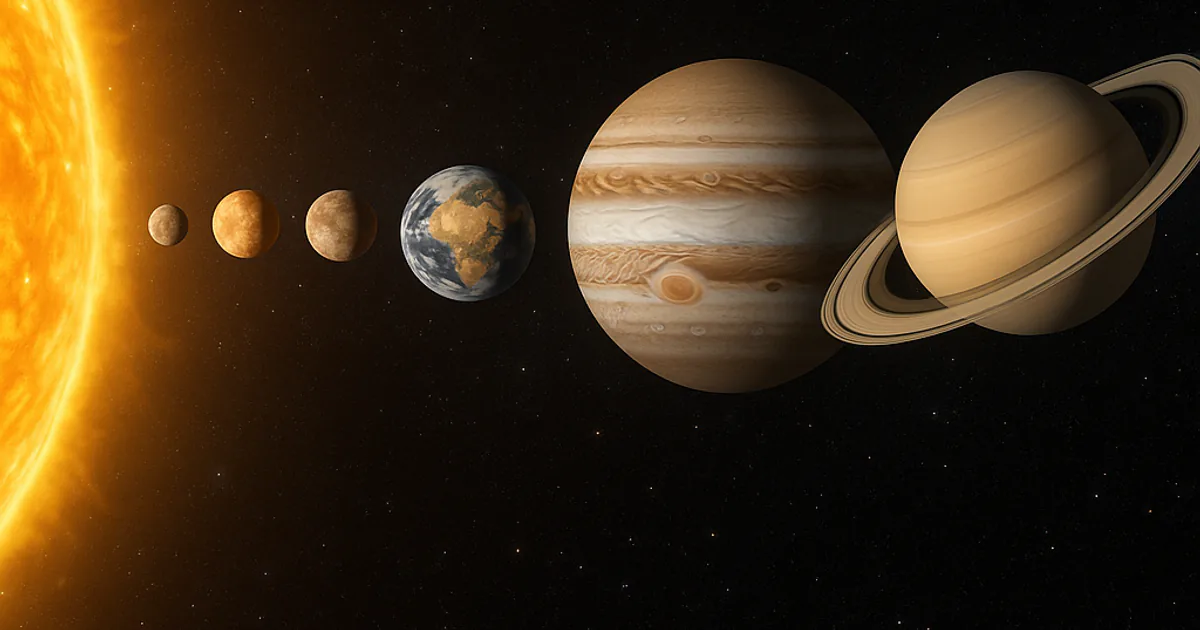
The solar system is the one neighborhood in the universe we have actually visited. Every planet has been photographed up close by a spacecraft, rovers have driven on Mars for decades, probes have landed on a comet, a moon of Saturn and the surface of Venus, and two of them have left the Sun's influence entirely. A solar system curriculum uses that record: the child is not memorizing a poster but reading the data from Cassini, Juno, New Horizons and Perseverance, building the scale that makes the numbers mean something, and following missions that are flying right now.
This guide is deliberately narrower than our broader space and astronomy unit study, which covers stars, rocketry and the history of exploration. Here the subject is the Sun's family — eight planets, the moons that outnumber them, the dwarf planets, asteroids and comets, and the robotic missions that revealed them — studied through scale models, real measurements, mission data and the kind of question a child asks first: could anything live on Europa, why is Venus hotter than Mercury, what happened to Pluto. Six weeks here fits inside an earth-and-space science credit at any level, and pairs naturally with the space guide before or after.
A sample week
Reading & Writing
Read the story of the Voyager Golden Record and what was put on it, then write the one-page message your family would send on the next probe leaving the solar system — and justify every choice.
Math
Build a scale model of the solar system on a sidewalk or a long hallway where the Sun is a grapefruit: calculate each planet's size and distance at that scale, mark them with chalk, and discover that the nearest star at the same scale is thousands of miles away.
Science
Make impact craters by dropping marbles from three heights into a tray of flour dusted with cocoa, measure crater width and ray length against drop height, and compare with real crater photographs from the Moon, Mercury and Mars.
Social Studies
Map every active planetary mission on a diagram of the solar system with its launching nation or agency and launch year, then write a paragraph on why the largest ones are now built by several countries together.
Art
Paint each planet from spacecraft photographs rather than a textbook diagram — Jupiter's storms from Juno, Mars's rust and blue sunsets from the rovers, Pluto's heart from New Horizons — with a caption noting which mission took the reference picture.
Get the 6-week planner + new unit ideas
A print-ready PDF of this solar system unit study — the six-week scope and sequence, grade-band notes, reading list and FAQs — plus an occasional email when a new interest guide goes up.
Adapting by grade
K-2 learners can learn the planets in order, sort them into rocky and gas giants, watch the Moon change shape over a month from the yard, and build the first scale model that shows how empty space is. The words are wonderful and free: Jupiter, Ganymede, asteroid, orbit.
Middle and high schoolers move into mechanisms and data: why the inner planets are rock and the outer ones gas, what gravity does to an orbit, how Kepler's third law lets you weigh a planet from its moon, and how to read a real mission's published measurements rather than a summary of them.
Activities by grade band
Grades K-2: eight worlds in order and a Moon that changes
Young children can learn the planets in order, tell a rocky planet from a gas giant, notice that the Moon has a shape tonight that it did not have last week, and grasp — through a walk down the street — that the planets are tiny and the spaces between them are huge. A K-2 solar system unit is naming, ordering, sorting and looking up, with a scale model as the centerpiece.
- Sidewalk solar system: with the Sun as a beach ball at the front door, walk the planets out with chalk using a ready-made scale (Mercury a few steps away, Neptune at the end of the block), and place a pea, a peppercorn or a marble for each. Then walk back and count the steps between Earth and Mars.
- Moon diary: every clear night for a month, draw the Moon's shape in a box on a chart and note whether it is getting bigger or smaller; at the end, cut the drawings out and arrange them in a circle to see the cycle.
- Rocky or gas: sort planet picture cards into two piles by what they are made of, then hold a rock and a balloon to feel the difference; add a third pile of 'too small and too far' for Pluto and the dwarf planets.
- Crater tray: drop marbles into a tray of flour dusted with cocoa from knee height and from shoulder height, look at the craters with a flashlight held low, and compare with a photograph of the Moon. Count the craters in one square of a Moon map.
Reading suggestion: There's No Place Like Space! by Tish Rabe, a Cat in the Hat's Learning Library tour of the planets in rhyme, and The Planets by Gail Gibbons for the same eight worlds in clear, labeled pictures.
Grades 3-5: planet by planet, with real numbers
Upper elementary students can hold the whole system as a structure — inner rock, outer gas, ice beyond — and can study each planet as an individual world with its own numbers: size, distance, day length, moons, temperature. This is the age for the first calculated scale model, the first data table comparing planets, the moon-phase model with a lamp, and reading the story of one mission from launch to landing.
- Calculate your own scale model: choose a Sun size (a grapefruit works), work out the diameter and distance of every planet at that scale with a calculator, and lay it out with a tape measure. Then compute where the nearest star would be at that scale and look it up on a map.
- Planet data table: for all eight planets, record diameter, distance from the Sun, length of a day, length of a year and number of known moons from NASA's fact sheets, then make two bar graphs and write three sentences about a pattern (day length is a good one — the giants spin fastest).
- Moon phases with a lamp: in a dark room, hold a ball at arm's length and turn slowly with a lamp as the Sun; sketch the lit shape at eight positions and match each to the name of the phase. Then explain why the Moon diary from the yard showed the same sequence.
- Follow one mission: read the story of the Curiosity or Perseverance rover from the book on the reading list, draw its route on a map of the landing site, and list five things it found. Then check the mission's website for what it did this week.
Reading suggestion: Curiosity: The Story of a Mars Rover by Markus Motum, told by the rover itself with the engineering shown, and the National Geographic Kids Space Encyclopedia for the planet-by-planet reference to keep open all unit.
Grades 6-8: gravity, scale and the evidence from the missions
Middle schoolers can move from description to mechanism — why the inner planets are rocky and the outer ones gas, how gravity shapes an orbit, why seasons happen and eclipses do not happen every month — and can work with real mission data rather than summaries. The NGSS middle-school space standards map directly onto this band, and the projects produce graphs, models and written arguments.
- Analyze scale properties: using NASA's planetary fact sheets, calculate each planet's density from its mass and diameter, graph density against distance from the Sun, and write an explanation of the pattern in terms of what could condense near the hot young Sun and what could not.
- Model the Earth-Sun-Moon system with a lamp and two balls to reproduce phases, then show why a solar eclipse needs the Moon's tilted orbit to cross the Sun's plane — and use an eclipse table to find the next one visible from your area.
- Read the New Horizons Pluto results as the mission team published them for the public — nitrogen glaciers, water-ice mountains, a possible subsurface ocean — and write a page arguing whether Pluto should be called a planet, using the 2006 definition and the evidence on both sides.
- Design a comet: mix water, dirt, a splash of syrup and dry ice (with gloves and adult supervision) into a 'dirty snowball', watch it outgas under a lamp, and explain what a comet's tail is, why it always points away from the Sun, and where comets come from.
Reading suggestion: The Planets by Dava Sobel, a planet-by-planet narrative that is history, myth and science together, and, for the mission side, chapters from Roving Mars by Steve Squyres, the scientist who led the Spirit and Opportunity rovers.
Grades 9-12: orbital mechanics, planetary science and mission design
High schoolers can use Kepler's laws and Newton's gravity to compute orbits and weigh planets, read the actual published results of a mission, and design a mission of their own with real constraints — launch windows, transfer orbits, power at Jupiter's distance, the trade between a flyby and an orbiter. Done with written analyses and a formal mission proposal, six weeks here is a substantial unit of a physics or earth-and-space science credit.
- Weigh Jupiter: look up the orbital period and radius of Ganymede (or any Galilean moon), apply Kepler's third law in its Newtonian form to compute Jupiter's mass, and compare with the accepted value; then repeat with the Moon to weigh Earth and comment on the error in each.
- Compute a Hohmann transfer orbit from Earth to Mars: the semi-major axis of the transfer ellipse, the travel time and the launch window spacing, and explain why Mars missions leave in clusters roughly every twenty-six months. Check your answer against the launch dates of real Mars missions.
- Read the abstract and figures of one peer-reviewed mission paper — Cassini's Enceladus plumes, Juno's gravity results on Jupiter's core, or the Perseverance sample results — and write a two-page summary of the question, the measurement, the result and what it changed.
- Write a mission proposal for a target of your choice — a Europa lander, a Venus balloon, a Uranus orbiter — with science goals, instruments, a launch window, a trajectory sketch, a power source justified by distance from the Sun, and a budget compared with a real mission of similar scope.
Reading suggestion: The Planets by Dava Sobel for the narrative spine, paired with the free OpenStax Astronomy textbook's solar system chapters for the orbital mechanics, planetary interiors and end-of-chapter problems a credit needs.
Six-week scope and sequence
| Week | Focus | Key activity | Output |
|---|---|---|---|
| 1 | The Sun's family and its scale | Sidewalk or hallway scale model, calculated by older students; the planets in order and in two families; the nearest star at the same scale; start the moon diary. | A photographed scale model with the calculations and a written reflection on how empty the solar system is. |
| 2 | The rocky worlds | Mercury, Venus, Earth and Mars compared in a data table; the crater experiment with graphs; why Venus is hotter than Mercury; the Mars rovers' route maps. | A planet comparison table with graphs and a crater lab write-up. |
| 3 | The giants and their moons | Jupiter and Saturn from Juno and Cassini images; the Galilean moons in binoculars; Enceladus, Titan and Europa as ocean worlds; density against distance for older students. | A moon field guide (drawings and facts for six major moons) or a density-versus-distance graph with an explanation. |
| 4 | Dwarf planets, asteroids and comets | The Pluto question with the 2006 definition and the New Horizons results; the asteroid belt and Ceres; a dry-ice comet; where the small bodies come from. | An argued position on Pluto's status with evidence, and a comet diagram with the tail explained. |
| 5 | Motion: orbits, phases, seasons and eclipses | The lamp-and-ball model; the moon diary completed and explained; Kepler's laws and weighing Jupiter for older students; the next eclipse found and marked. | A completed month-long moon diary with the explanation, and for older students the Kepler calculation. |
| 6 | The missions | Map every active mission; the Voyager Golden Record; read one mission's results; design and present a mission of your own with target, instruments and trajectory. | A mission proposal presented to the family, or an illustrated mission map with a written history of exploration. |
Standards this unit covers
- 1-ESS1-1 (NGSS) — Use observations of the sun, moon and stars to describe patterns that can be predicted — the K-2 moon diary.
- 5-ESS1-2 (NGSS) — Represent data in graphical displays to reveal patterns of daily changes in length and direction of shadows, day and night, and the seasonal appearance of some stars in the night sky — the moon and shadow logs.
- 5-PS2-1 (NGSS) — Support an argument that the gravitational force exerted by Earth on objects is directed down — the first step toward gravity as the shaper of orbits.
- MS-ESS1-1 (NGSS) — Develop and use a model of the Earth-sun-moon system to describe the cyclic patterns of lunar phases, eclipses of the sun and moon, and seasons — the lamp-and-ball model.
- MS-ESS1-2 (NGSS) — Develop and use a model to describe the role of gravity in the motions within galaxies and the solar system — orbits and the comet's path.
- MS-ESS1-3 (NGSS) — Analyze and interpret data to determine scale properties of objects in the solar system — the scale model and the density graph.
- HS-ESS1-4 (NGSS) — Use mathematical or computational representations to predict the motion of orbiting objects in the solar system — Kepler's laws, weighing Jupiter and the Hohmann transfer.
- CCSS.MATH.CONTENT.6.RP.A.3 (CCSS Math) — Use ratio and rate reasoning to solve real-world and mathematical problems — every scale-model calculation.
- CCSS.ELA-LITERACY.RST.9-10.7 (CCSS ELA) — Translate quantitative or technical information expressed in words into visual form and vice versa — reading mission figures and writing them up.
Recommended books, sites and kits
- There's No Place Like Space! by Tish Rabe (Book (K-2)) — The Cat in the Hat tours the eight planets in rhyme; the week-one read-aloud for the youngest.
- Curiosity: The Story of a Mars Rover by Markus Motum (Book (3-5)) — The rover narrates its own design, launch and landing; the mission book for the middle grades.
- National Geographic Kids Space Encyclopedia (Book (3-8)) — Planet-by-planet spreads with mission photographs and the numbers the data table needs.
- The Planets by Dava Sobel (Book (9-12)) — One essay per planet blending science, history and myth; the high-school spine and a strong read-aloud for 6-8.
- NASA Solar System Exploration (science.nasa.gov/solar-system) (Website) — Free fact sheets for every planet, moon and mission, the source of every number in the unit and of public-domain images.
- NASA's Eyes on the Solar System (Website) — A free 3D simulation that shows where every planet and active spacecraft is right now, with playback of past and future trajectories.
- Stellarium (Website) — Free planetarium software (desktop and web) that shows which planets are up tonight from your own backyard.
- Crash Course Astronomy (Phil Plait) (Video series) — Short episodes on each planet, the moons, asteroids, comets and the Kuiper Belt at high-school depth; one or two per week.
Common questions
What should a solar system unit study include?
Five strands: the Sun and the planets as a family with a structure (rocky worlds inside, giants outside, ice beyond), each planet and its moons as an individual world, the small bodies — dwarf planets, asteroids, comets — and what they tell us about the system's origin, the scale and motion of it all (orbits, gravity, seasons, phases), and the missions that gathered the evidence. The six-week scope and sequence above runs one strand a week and ends with a mission the child designs and defends.
How is this different from your space and astronomy unit study?
The space guide is wide: stars and galaxies, rocketry and how launches work, the history of exploration from Sputnik to today, and the humanities that surround it. This guide stays inside the Sun's family and goes world by world — the eight planets, their major moons, Pluto and the other dwarf planets, asteroids and comets — through scale, data and the robotic missions that visited them. Many families run the solar system first as the concrete foundation and the space guide afterwards for everything beyond it; the two are written to fit together.
Do we need a telescope?
No. Five planets are visible to the naked eye and a child who has spotted Jupiter and Saturn from the driveway will never forget which is which; free planetarium software on the resource list shows what is up tonight. Ordinary binoculars show Jupiter's four big moons as points of light, which is what Galileo saw in 1610. A telescope is a rewarding upgrade for Saturn's rings and the Moon's craters, but everything in this guide works without one.
Is Pluto a planet? How do we teach that?
Teach it as the best example in the unit of how science works. In 2006 the International Astronomical Union defined a planet as a body that orbits the Sun, is round under its own gravity and has cleared its orbit of other objects; Pluto meets the first two but shares its neighborhood with thousands of Kuiper Belt objects, so it became the first dwarf planet, alongside Ceres, Eris, Haumea and Makemake. When New Horizons flew past in 2015 it found a world with mountains of water ice and glaciers of nitrogen. The category changed; the object got more interesting. That is a week-three discussion at every grade.
How much of this is real science versus memorizing facts?
The facts are the raw material; the science is in the scale models, the measurements and the data. A sidewalk model teaches ratio and the size of nothing; the crater experiment is a controlled test with a graph; the moon-phase log is a month of observation that explains itself; and older students weigh Jupiter from Ganymede's orbit with Kepler's law, compare planets in a spreadsheet and read what a mission actually measured. A child who finishes this unit knows the planets in order — and knows why they are in that order.
Can I run this with several ages at once?
Yes, and the scale model is the shared spine. Everyone walks the same sidewalk; a kindergartner places the planets in order, a fourth grader calculates the spacing, a seventh grader adds the moons and the asteroid belt to scale, and a tenth grader works out how long light takes to cross it. The crater tray, the moon log and the mission map are equally shared. The grade-band sections above are written so you can pick one row per child from one week.
Does this unit work for secular and faith-based homeschools alike?
Yes. The content is observation, measurement, orbital motion and the record of spacecraft missions, and the activities are identical in either setting. Where the reading touches the age and formation of the solar system — the 4.6-billion-year figure and the nebular model, in the 6-8 and 9-12 bands — it is noted so families can present it in whatever framework fits their convictions. The scale, the craters, the phases and the mission data are the same for everyone.
How much does a solar system unit study cost?
Under fifteen dollars. Sidewalk chalk, a grapefruit, marbles, flour and cocoa, a tape measure and a notebook cover the hands-on work; a set of foam balls for a hanging model is optional. Every website, dataset and piece of software on the resource list is free, NASA's image archives are public domain, and the reading spine is one library book per grade band.
Related curriculum ideas
 Space & Astronomy homeschool curriculum
Build a K-12 homeschool curriculum around space — astronomy, rocketry, and the history of exploration woven through reading, math and science.
 Robots & Coding homeschool curriculum
Build a homeschool curriculum around robots and coding — programming, engineering design, math and the ethics of automation, for K-12.
 Volcanoes & Geology homeschool curriculum
A homeschool curriculum built around volcanoes and geology — plate tectonics, rocks, deep time and natural hazards, for K-12 learners.
Turn this into a full curriculum
Generate a complete, standards-aligned curriculum around this interest in minutes — free to try, no account required.